
- Log of the Moira
- Finding the Thread
- Cruising Asia
- Cruising the Solomon Islands
- Cruising Australia Part 1
- Cruising Papua New Guinea
- Pearls, Pearls, Pearls
- What Am I Doing Here?
- Black, White and Grey in Paradise
- Dubious Mission to Tagula
- Words Appart
- Rascals in Paradise
- Pearl Diving in Doga Sui Sui Pass
- American Spies
- The Giant Man Eating Octopus
- The Great Ebony Caper
- The Uplift Factor
- Planned Failure
- A Tangled Web
- Opposition
- Midnight Sun
- Lapi in the Isles of Love
- Unchartered Waters
- Unnamed Island
- The Isles of Love
- Earthlings
- Nothing Atoll
- Super-Organisms in Time Lapse
- People of the Sea
- Coral Fires Burning
- Symbiotic Coral Megabeasts
- Symbiosis
- A Handy Experiment
- Destiny in Action
- Keops and Kaleidoscopes
- Poisoned and Dying in Sidea
- Dire Straits
- PNG Update
- Cruising Australia Part 2
- Ancient Respected Oracle
- Eye of the Dolphin
- Sydney Dolphin Cult
- Water Wings
- Sydney Dolphin Connection
- Sydney's Dolphinarium
- Dolphin communication
- Starlight Starbright
- Captive Dolphins
- Politics of dolphin liberation
- Sun Heralds Sydney Dolphins
- 40 foot swimming pool
- Media Dolphin Campaign
- Government Goo
- Dolphins in captivity
- Dolphin Referendum
- Australian Media Campaign
- Dolphins to die
- Orcas Visit Moira
- Dolphin Update
- Man and Dolphin
- Cruising New Caledonia
- Cruising Fiji
- Cruising Samoa
- This Magic Sea
- We are
- Awareness
- Learning
- We Voyage This Magic Sea
- Bound for Knowledge
- Beyond Perceptual Horizons
- Facts of Life
- Intercommunications
- Sea's Communication Webs
- Appearing
- 4 Phase Process of Becoming
- Thread of Awareness
- Error of Expectations
- Change of Expectations
- Mind
- Learning
- Fields of Perception
- Guides
- Tides
- Thread of Awareness
- Contact The Moira
E-BOOK VERSIONS
Enjoy these adventures on your ebook reader and help support the Thread of Awareness network of websites by downloading the Log of The Moira ebooks in epub and mobi formats for €5 per ebook or €10 for all three ebooks.
The Complete Series of all three ebooks.
Bacterial Illumination
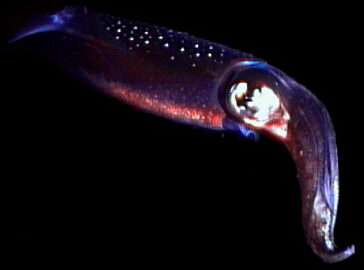
Squid Communicate with each other using a wide spectrum of colors and postures. At night they signal with luminescent organs.
The squid's luminescent communications result from communications between bacteria living in special light organs.
Squid, and a variety of fish, have luminescent bacteria housed in special sacs called light organs. The bacteria generate light with an enzyme called luciferase - but not all the time.
When the bacteria Vibrio fischeri swim free in sea water, their population densities are very low and they do not produce light. When they inhabit the light organs of squid, however, the squid cells nurture the bacteria and their populations soar to high levels. When the bacteria are packed tight, they begin to secrete messenger proteins called autoinducer. As this reaches a critical level, it enters the bacteria and activates a protein called LuxR.
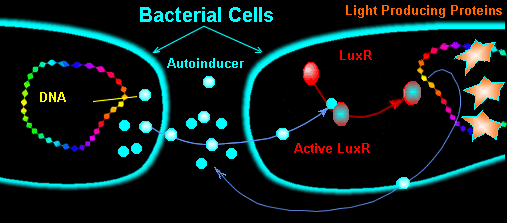 |
Activated LuxR stimulates the bacterial genes to produce the light producing proteins luciferin, luciferase and associated light producing proteins.
The genes are stimulated to produce additional autoinducer messengers and these are released from the bacteria. The additional production of autoinducer messengers, triggered by the active LuxR, stimulate another round of protein synthesis. This positive feedback loop results in rapid production of light producing proteins. When these proteins reach a critical density, they react with each other to liberate that delightfully eerie blue phosphorescence of the sea.
