
- Log of the Moira
- Finding the Thread
- Cruising Asia
- Cruising the Solomon Islands
- Cruising Australia Part 1
- Cruising Papua New Guinea
- Pearls, Pearls, Pearls
- What Am I Doing Here?
- Black, White and Grey in Paradise
- Dubious Mission to Tagula
- Words Appart
- Rascals in Paradise
- Pearl Diving in Doga Sui Sui Pass
- American Spies
- The Giant Man Eating Octopus
- The Great Ebony Caper
- The Uplift Factor
- Planned Failure
- A Tangled Web
- Opposition
- Midnight Sun
- Lapi in the Isles of Love
- Unchartered Waters
- Unnamed Island
- The Isles of Love
- Earthlings
- Nothing Atoll
- Super-Organisms in Time Lapse
- People of the Sea
- Coral Fires Burning
- Symbiotic Coral Megabeasts
- Symbiosis
- A Handy Experiment
- Destiny in Action
- Keops and Kaleidoscopes
- Poisoned and Dying in Sidea
- Dire Straits
- PNG Update
- Cruising Australia Part 2
- Ancient Respected Oracle
- Eye of the Dolphin
- Sydney Dolphin Cult
- Water Wings
- Sydney Dolphin Connection
- Sydney's Dolphinarium
- Dolphin communication
- Starlight Starbright
- Captive Dolphins
- Politics of dolphin liberation
- Sun Heralds Sydney Dolphins
- 40 foot swimming pool
- Media Dolphin Campaign
- Government Goo
- Dolphins in captivity
- Dolphin Referendum
- Australian Media Campaign
- Dolphins to die
- Orcas Visit Moira
- Dolphin Update
- Man and Dolphin
- Cruising New Caledonia
- Cruising Fiji
- Cruising Samoa
- This Magic Sea
- We are
- Awareness
- Learning
- We Voyage This Magic Sea
- Bound for Knowledge
- Beyond Perceptual Horizons
- Facts of Life
- Intercommunications
- Sea's Communication Webs
- Appearing
- 4 Phase Process of Becoming
- Thread of Awareness
- Error of Expectations
- Change of Expectations
- Mind
- Learning
- Fields of Perception
- Guides
- Tides
- Thread of Awareness
- Contact The Moira
E-BOOK VERSIONS
Enjoy these adventures on your ebook reader and help support the Thread of Awareness network of websites by downloading the Log of The Moira ebooks in epub and mobi formats for €5 per ebook or €10 for all three ebooks.

The Complete Series of all three ebooks.
For your mermaid.

The Fire Ant Treaty
You will never forget fire ants if they get you.
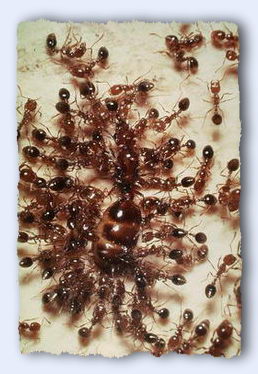 They've killed people. Venomous little monsters. When a field gets
infested with them, well, it's almost impossible to go out fiddling with your crops. Their
huge nests - rock hard - make plowing difficult, too. Fire ants stung the field of biology
not long ago. Specifically the geneticists who thought they knew about genes and such.
Solenopsis richteri arrived uninvited from South America at Mobile, Alabama. They spread
through the southeastern U.S. like a wildfire.
They've killed people. Venomous little monsters. When a field gets
infested with them, well, it's almost impossible to go out fiddling with your crops. Their
huge nests - rock hard - make plowing difficult, too. Fire ants stung the field of biology
not long ago. Specifically the geneticists who thought they knew about genes and such.
Solenopsis richteri arrived uninvited from South America at Mobile, Alabama. They spread
through the southeastern U.S. like a wildfire.
Fire ants evolve - or learn - to outwit biologists faster than biologists learn to fight them. Think up a new attack. Ants think up a new defense. They keep spreading from one State to the next.
Entomologists are not terribly curious about how the ants manage to come up with new defenses against the poisons - they suppose it is due to random mutations. Cosmic rays, yet. Or maybe the chemicals themselves mess up the ant genes so they mutate into new mutants, some of ants turn out to be able to resist the poisons, so these survive and prosper. That's what the biologists suppose.
The ants showed them otherwise.
Somewhere, in America's Southeast, perhaps near a research station trying new chemical pesticides, mechanical destructive devises, and electronic traps, a queen ant altered its behavior. Fire ants don't get along with other nests of fire ants. They fight and defend their turf to the last ant. Soldier ants sally forth to attack any member of another mound found within its territory. Agricultural fields were a network of isolated information systems; each colony defined by a single queen.
One queen, one colony, one information system.
It may be, what with all the pressure from the energetic biologists at the research station, one queen figured it might be a good idea to have some help restocking the ranks. So she tried allowing another queen to help out. Her colony was redefined as a two queen nest. Meaning, of course, two sets of genes, two information networks, had to get along with each other in the same nest. Truce. However they managed to solve this breech in genetic decorum, it had an unexpected bonus - for the ants.
Other nests were no longer the enemy, but became part of a still larger network of information. With many queen ants. The revolutionary multi-queen ant colonies, working with their socialist allies, constructed enormous nests with hundreds of queens. The network of tunnels and sub-nests spread until whole fields became one single information system. Instead of attacking each other they only went after farmers, cattle, people who picnicked in the wrong place, dogs and, naturally, biologists.
Geneticists think the behavior of each individual ant, queen or worker, is controlled by that individual's genetic code; locked and unchangeable except, perhaps, by chance mutation. If chemical mutation created the new behavior in the queen ant that started the new system, she would only spread it to her direct descendents. The spread of this new genetic mutation would be easy to measure as it moved across the Southeastern United States. Ho ho! Surprise. The new behavior spread far more quickly than could be accounted for by the spread of progeny. It moved across America like a new idea; as if the population network of the multitude of isolated fire ant nests were converted to a new concept.
The message from the fire ant queens is that the cosmic ray chance mutation theory sucks. Geneticists have not been able to solve this problem - there is something, some basic something, wrong with the way we think about genes and how they get changed. Fire ants, as anyone who has been bit by one knows, are determined, objective little creeps. They don't do anything by chance.
A wild guess.
Ants communicate their need to fight or agreement to live together by chemical signals. One queen, somewhere, learned to make a chemical that signaled peace. Make love not war. Some sticky note on the antennae of the soldier ants saying, "welcome."
Now suppose the ants have a physiological method of passing on new messages. A kind of molecular copy machine. A new flavor message arrives. It is a big surprise because it kicks off the "Your OK, I'm OK, let's not fight" behavior pattern.
A surprise because the ant with the sticky note is not from the same nest at all but from another nest. Once the sticky note gets on the antenna of an ant, it gets reproduced and passed on. The molecular message triggers the ants to make more of it. A simple molecular sticky note; "don't fight with me" or "love me, I'm one of yours." And once tasted, it alters the genetic production of chemical messages of all the ants that get contacted. Something like a virus - and maybe it actually was a virus that began the sequence. This would allow the "mutation" to spread throughout the Southeastern part of the U.S. as fast as ants could touch each other. Which, evidently, was pretty fast.
Who says things learned during one lifetime can't alter the genetic code and be passed along to the young?
To me, the story sounds very much like Christianity. The elite Jewish community deciding to allow non-jews entry to the Kingdom so everyone can get along better in this life. So far, the ants seem to carry it off better. But it's early days, yet. I'll bet there are some protestent fire ants out there just getting ready to attack.
