
- Log of the Moira
- Finding the Thread
- Cruising Asia
- Cruising the Solomon Islands
- Cruising Australia Part 1
- Cruising Papua New Guinea
- Pearls, Pearls, Pearls
- What Am I Doing Here?
- Black, White and Grey in Paradise
- Dubious Mission to Tagula
- Words Appart
- Rascals in Paradise
- Pearl Diving in Doga Sui Sui Pass
- American Spies
- The Giant Man Eating Octopus
- The Great Ebony Caper
- The Uplift Factor
- Planned Failure
- A Tangled Web
- Opposition
- Midnight Sun
- Lapi in the Isles of Love
- Unchartered Waters
- Unnamed Island
- The Isles of Love
- Earthlings
- Nothing Atoll
- Super-Organisms in Time Lapse
- People of the Sea
- Coral Fires Burning
- Symbiotic Coral Megabeasts
- Symbiosis
- A Handy Experiment
- Destiny in Action
- Keops and Kaleidoscopes
- Poisoned and Dying in Sidea
- Dire Straits
- PNG Update
- Cruising Australia Part 2
- Ancient Respected Oracle
- Eye of the Dolphin
- Sydney Dolphin Cult
- Water Wings
- Sydney Dolphin Connection
- Sydney's Dolphinarium
- Dolphin communication
- Starlight Starbright
- Captive Dolphins
- Politics of dolphin liberation
- Sun Heralds Sydney Dolphins
- 40 foot swimming pool
- Media Dolphin Campaign
- Government Goo
- Dolphins in captivity
- Dolphin Referendum
- Australian Media Campaign
- Dolphins to die
- Orcas Visit Moira
- Dolphin Update
- Man and Dolphin
- Cruising New Caledonia
- Cruising Fiji
- Cruising Samoa
- This Magic Sea
- We are
- Awareness
- Learning
- We Voyage This Magic Sea
- Bound for Knowledge
- Beyond Perceptual Horizons
- Facts of Life
- Intercommunications
- Sea's Communication Webs
- Appearing
- 4 Phase Process of Becoming
- Thread of Awareness
- Error of Expectations
- Change of Expectations
- Mind
- Learning
- Fields of Perception
- Guides
- Tides
- Thread of Awareness
- Contact The Moira
E-BOOK VERSIONS
Enjoy these adventures on your ebook reader and help support the Thread of Awareness network of websites by downloading the Log of The Moira ebooks in epub and mobi formats for €5 per ebook or €10 for all three ebooks.


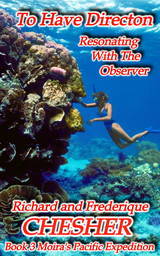
The Complete Series of all three ebooks.
For your mermaid.

FRACTAL IMAGES
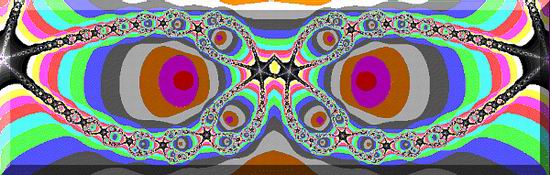 |
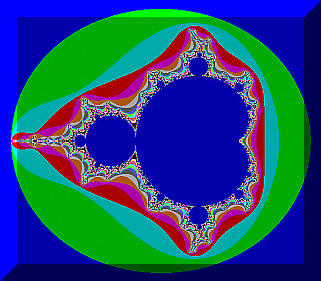 Fractal images are fun and you can download several free fractal generation programs on the Internet.
I like ChaosPro but there are many others and you can find an excellent list of fractal programs to download on Fractal Arts. For a more extensive list of fractal websites visit this site.
Fractals are a new discovery. Without computers nobody would have discovered them and without computers nobody would be looking at them.
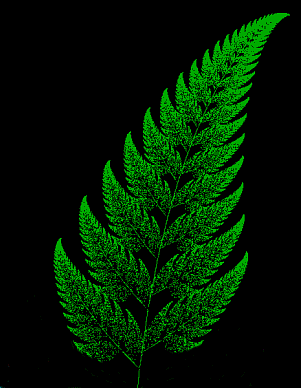
Fractal math resulted in the development of Iterated Function Systems (IFS) that map a region of two dimensional space onto itself using a very small set of functions. The information needed to generate this fern, for example, is in a "seed" file with only 7 numbers in four sets (28 numbers total). Each set has 4 matrix numbers, two vector numbers and a single probability number.
A whole forest has been "mapped" onto a file of just 300,000 bytes. In any case, fractals are a very useful metaphor for understanding life.
Individual concepts - either thoughts or creatures - are like part of a fractal curve. One part of the design has an individual shape, with similar ones nearby. Each part is clearly different from its surroundings: different from the larger design it is part of, different from the smaller designs of its fine detail. But it does not exist by itself.
The existence and resolution of the fractal design depends on how many times the computer solves the fractal equation. If the equation is solved only a few thousand times, the design may not be visible at all.
Fractals are the surprising patterns that develop by graphing formulas of complex numbers on the two coordinates of your computer screen. The x axis (horizontal) represents real or ordinary numbers.
The y axis (vertical) represents imaginary numbers (real numbers multiplied by the square root of minus 1).
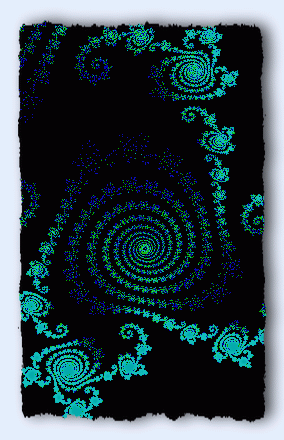 In a metaphoric sense, this resembles the creation of awareness and its subsequent remaping of probabilities. Biological systems are exposed to real numbers. They "map" these real numbers - expecting that future real numbers will be equal to those already experienced. The mapped numbers held in memory are imaginary, in the sense that they are expectations or representations of real numbers and exist on an imaginary plane. When imaginary numbers and real numbers turn out to be the same (or close enough not to trigger the sensory system), the result is nothing. No reaction, no dot on the display screen. In the Fractal shown to the left, no reaction is represented by black.
In the Mandelbrot fractal images no dot is represented by blue. When the expected number and the real one are not the same, the difference generates a point of awareness. The degree of difference between expected and real determines the degree of response. Because the sensors are all in different positions relative to the incoming signals, their combined flow of binary responses impose a second level of iteration in the next highest portion of the parallel computer - for example passing the information to processor clusters in the brain.
The internal computations are all very simple equations done on binary (yes-no) numbers and repeated millions upon millions of times per second. The operation of the retina of the eye is a reasonable example of what might be called parallel processing of fractal images.
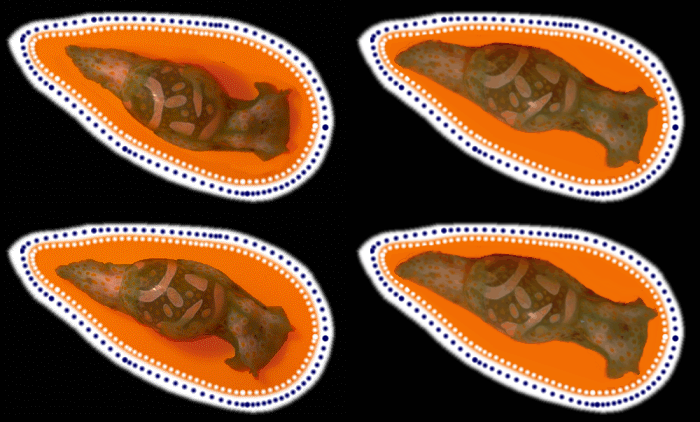 A sea shell's decision to turn left or right is also based on hundreds or thousands of iterations of incoming sensory information matching real numbers against imaginary remembering. Threading into the equation is the internal state of the sea shell - hungry, frightened, sexually stimulated, searching for darkness or the light. The fractal equation of awareness, the constant remaping of real and imaginary based on surprise, has been solved by the experience of awareness learning new ways to minimize the error of expectations over several billion years.
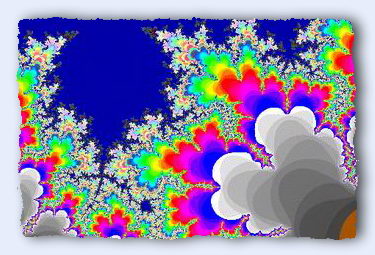 Any one part of the structure of life on our planet - you or me, for instance - is clearly different from its surroundings and from the larger and smaller designs it is part of. But if we look closely enough at ourselves we find we are comprised of little iterations of becoming and if we look around ourselves we see we belong to larger iterations of becoming. And just like the fractal designs, no matter how closely you look, each pattern is similar, yet different from any other one.
