
- Log of the Moira
- Finding the Thread
- Cruising Asia
- Cruising the Solomon Islands
- Cruising Australia Part 1
- Cruising Papua New Guinea
- Pearls, Pearls, Pearls
- What Am I Doing Here?
- Black, White and Grey in Paradise
- Dubious Mission to Tagula
- Words Appart
- Rascals in Paradise
- Pearl Diving in Doga Sui Sui Pass
- American Spies
- The Giant Man Eating Octopus
- The Great Ebony Caper
- The Uplift Factor
- Planned Failure
- A Tangled Web
- Opposition
- Midnight Sun
- Lapi in the Isles of Love
- Unchartered Waters
- Unnamed Island
- The Isles of Love
- Earthlings
- Nothing Atoll
- Super-Organisms in Time Lapse
- People of the Sea
- Coral Fires Burning
- Symbiotic Coral Megabeasts
- Symbiosis
- A Handy Experiment
- Destiny in Action
- Keops and Kaleidoscopes
- Poisoned and Dying in Sidea
- Dire Straits
- PNG Update
- Cruising Australia Part 2
- Ancient Respected Oracle
- Eye of the Dolphin
- Sydney Dolphin Cult
- Water Wings
- Sydney Dolphin Connection
- Sydney's Dolphinarium
- Dolphin communication
- Starlight Starbright
- Captive Dolphins
- Politics of dolphin liberation
- Sun Heralds Sydney Dolphins
- 40 foot swimming pool
- Media Dolphin Campaign
- Government Goo
- Dolphins in captivity
- Dolphin Referendum
- Australian Media Campaign
- Dolphins to die
- Orcas Visit Moira
- Dolphin Update
- Man and Dolphin
- Cruising New Caledonia
- Cruising Fiji
- Cruising Samoa
- This Magic Sea
- We are
- Awareness
- Learning
- We Voyage This Magic Sea
- Bound for Knowledge
- Beyond Perceptual Horizons
- Facts of Life
- Intercommunications
- Sea's Communication Webs
- Appearing
- 4 Phase Process of Becoming
- Thread of Awareness
- Error of Expectations
- Change of Expectations
- Mind
- Learning
- Fields of Perception
- Guides
- Tides
- Thread of Awareness
- Contact The Moira
E-BOOK VERSIONS
Enjoy these adventures on your ebook reader and help support the Thread of Awareness network of websites by downloading the Log of The Moira ebooks in epub and mobi formats for €5 per ebook or €10 for all three ebooks.


The Complete Series of all three ebooks.
For your mermaid.

The Hive and the Brain
No, no, you've got it right the wrong way round.
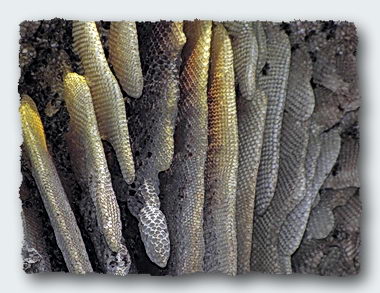
The bees make the hive, the hive doesn't make the bees. Although you'd be hard pressed to prove it if you began with the wrong viewpoint. Carefully dissecting the hive to determine how it makes bees, you'd come to the miraculous honey comb and within its octagonal sockets find the bees in their various stages of construction.
Ahh Ha! Here we are, the very heart of the industry. Here is where the hive constructs the bees, you can see it happening.
We could then become highly philosophical, perhaps over a few beers at the club, on the strange relationship between the animated little packets of energy (that behave so like particles zooming about) and the convoluted, complex anatomy of the hive that directs all the action. Further experiments would demonstrate that prodding the hive just here or over there results in even more animated action of the bees. We know, through dedicated beeing experiments that if we take a solitary bee from the hive it dies in a couple of days. Two bees can survive a week or two outside the hive. It takes at least 40 to maintain a small hive. But normally a hive has about 50,000 beecells zooming about, gathering nourishment from about 2.5 kmē of territory.
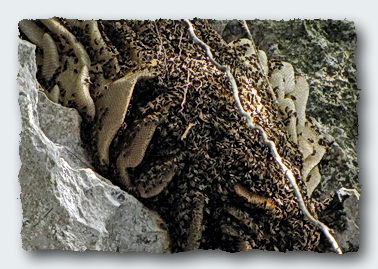
The Living Hive
The Hive breathes, circulates, metabolizes, regulates it temperature, defends itself, eats, drinks, mates and procreates. The hive is clearly the living entity that constructs the bees.
The Hive communicates with other hives and thinks internally, for itself.
Karl von Frisch, in the 1920's and 30's mentally adjusted his thinking until he became able to understand bee language. Scout bees discover nectar and return to the hive. There, the scout dances to tell the other bees exactly where the nectar is. It does a figure 8 on the honeycomb and the axis of the 8 points the direction of the yummy, relative to the position of the sun. The tempo tells how far it is; near rates a fast tempo, far is less enthusiastic. The wings beat 250 cycles per second (the key of B, naturally) for a precise interval to explain how far the other bees must fly to get to the nectar.
Sex and food. Just like us humans hives talk about sex and food all the time. When the hive is ready to child itself, out go the scouts to check out prospective nest sites. Tentacles reaching out. These come back and the hive sits there humming over the various possibilities. Wag dance, same dance lots of times if the scout really thinks it is a great spot. When the deliberations get down to a few places, out go the scouts again to check them out. Back again and hum, buzz, dance till the hive settles on a spot to swarm to.
One of Dr. von Frish's hives took two weeks to decide, couldn't make up its mind, said what the hell and built the hive in a terrible spot and froze to death the next winter.
Austrian hives have a different dialect to Italian hives. Indian hives different again. Put an Indian bee in an Austrian hive and it acts like a dumb immigrant, always heading off in the wrong direction.
So, no doubt. Hives make bees.
Hopelessly wrong. The bees make the hive. And make more of themselves within the hive they have built. Just so.
And the mind makes the brain, not the other way around. The process of perception, memory, reaction constructs the brain from a single fertilized egg to its finished, operational stage. And the mind maintains the brain while making more thoughts, more memories, and more elaborate reactions all day and all night. The scout neurons bring information back into the brain, especially information on sex and food, and the whole mass of neurons hum and buzz and dance until they decide on what to do to get the food and the sex.
You can't fool me. The brain isn't the least bit a physical thing - it's a rapidly flowing dynamic of atoms and molecules dancing a whiz-dinger of a fandango.
How could anyone possibly suppose the physical brain produces the mind?(Click here to go to the solution of the hand experiment)?
