
- Log of the Moira
- Finding the Thread
- Cruising Asia
- Cruising the Solomon Islands
- Cruising Australia Part 1
- Cruising Papua New Guinea
- Pearls, Pearls, Pearls
- What Am I Doing Here?
- Black, White and Grey in Paradise
- Dubious Mission to Tagula
- Words Appart
- Rascals in Paradise
- Pearl Diving in Doga Sui Sui Pass
- American Spies
- The Giant Man Eating Octopus
- The Great Ebony Caper
- The Uplift Factor
- Planned Failure
- A Tangled Web
- Opposition
- Midnight Sun
- Lapi in the Isles of Love
- Unchartered Waters
- Unnamed Island
- The Isles of Love
- Earthlings
- Nothing Atoll
- Super-Organisms in Time Lapse
- People of the Sea
- Coral Fires Burning
- Symbiotic Coral Megabeasts
- Symbiosis
- A Handy Experiment
- Destiny in Action
- Keops and Kaleidoscopes
- Poisoned and Dying in Sidea
- Dire Straits
- PNG Update
- Cruising Australia Part 2
- Ancient Respected Oracle
- Eye of the Dolphin
- Sydney Dolphin Cult
- Water Wings
- Sydney Dolphin Connection
- Sydney's Dolphinarium
- Dolphin communication
- Starlight Starbright
- Captive Dolphins
- Politics of dolphin liberation
- Sun Heralds Sydney Dolphins
- 40 foot swimming pool
- Media Dolphin Campaign
- Government Goo
- Dolphins in captivity
- Dolphin Referendum
- Australian Media Campaign
- Dolphins to die
- Orcas Visit Moira
- Dolphin Update
- Man and Dolphin
- Cruising New Caledonia
- Cruising Fiji
- Cruising Samoa
- This Magic Sea
- We are
- Awareness
- Learning
- We Voyage This Magic Sea
- Bound for Knowledge
- Beyond Perceptual Horizons
- Facts of Life
- Intercommunications
- Sea's Communication Webs
- Appearing
- 4 Phase Process of Becoming
- Thread of Awareness
- Error of Expectations
- Change of Expectations
- Mind
- Learning
- Fields of Perception
- Guides
- Tides
- Thread of Awareness
- Contact The Moira
E-BOOK VERSIONS
Enjoy these adventures on your ebook reader and help support the Thread of Awareness network of websites by downloading the Log of The Moira ebooks in epub and mobi formats for €5 per ebook or €10 for all three ebooks.


The Complete Series of all three ebooks.
For your mermaid.
Each one of us knows awareness at our own interval of change,
but we change together on many levels, at intervals too fast, too slow for any one to know.
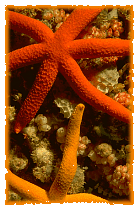
Two starfish sit side by side on the sea floor. To our eyes, they are unmoving, unchanging. If we could look at them at longer intervals, in time-lapse, we would see them moving rapidly, tracing their communication web on the sea floor. If we could observe them from very close up (millimicrons) at very short intervals (nannoseconds), we would be able to see the elements of sea water passing through the starfish.
Thus, the starfish are changing at intervals too slow and too fast for our human senses to perceive. At intervals, set by the rate of communications between our cells and our contextural status, we communicate with ourself in the past (memory) to observe how our environment changed from the last time we checked. We then project this change into an imagined future and then compare the changes again to see if the prediction was right.
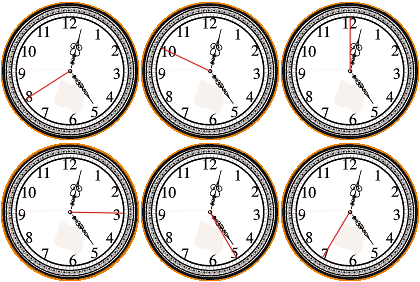
If you look at an electric clock with an analog dial, you can easily see a second hand of a clock moving, but seeing the minute hand move requires patience. You can't see the hour hand move, it moves too slowly for us to perceive.
The blades of a fan, spinning at high speed, look like a circular, translucent disk. But other creatures, like a bat, can perceive at faster intervals of awareness than we can. They see fan blades as individual blades. They can even fly between the blades to get into and out of ventilated buildings.
Cells perceive changes in the frequency of light, and have an interval of awareness measured in nanno-seconds, thousands of times faster than the interval of awareness of our collective being.
Other cells of our body detect changes in microwaves, also measured in frequencies of changes far beyond our conscious interval of awareness.
Cellular communications require time for the nerve signal to propagate along the axon and time for the molecular neuro transmitters to go between one nerve cell and the next and more time to assemble all the cellular perceptions and integrate these into a perception of the whole environment.
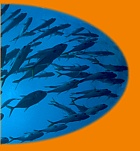
Individuals within a society have a faster interval of awareness than the whole group.
A single fish in a school might detect a predator in 1/50th of a second. It transmits this knowledge to other fish around it by signals generated by its body movements. The other fish sense this news and respond.
Over a few seconds, the whole school modifies its behavior to the presence of the predator, even though many of the individual fish are not in a position to perceive the predator themselves.

On a human time scale, a particular discovery may appear in a scientist's mind in a second. It may take years to test the idea and put this discovery into words others can understand.
The perception is then considered by other scientists and related to information coming in from other sources. The information is either ignored or passed along to the whole community of scientists, and perhaps to the public as well.

Not long ago, this process would require months to spread throughout a particular language system and years to spread through civilization. Even if everyone thought it was an important concept.
Today, the interval of awareness of civilization is greatly accelerated. The planet is entirely covered with an electronic web of communication. Information flows through it at the speed of light. A new and important discovery becomes known to civilization within days, or even minutes, if the news is of sufficient interest.
