
- Log of the Moira
- Finding the Thread
- Cruising Asia
- Cruising the Solomon Islands
- Cruising Australia Part 1
- Cruising Papua New Guinea
- Pearls, Pearls, Pearls
- What Am I Doing Here?
- Black, White and Grey in Paradise
- Dubious Mission to Tagula
- Words Appart
- Rascals in Paradise
- Pearl Diving in Doga Sui Sui Pass
- American Spies
- The Giant Man Eating Octopus
- The Great Ebony Caper
- The Uplift Factor
- Planned Failure
- A Tangled Web
- Opposition
- Midnight Sun
- Lapi in the Isles of Love
- Unchartered Waters
- Unnamed Island
- The Isles of Love
- Earthlings
- Nothing Atoll
- Super-Organisms in Time Lapse
- People of the Sea
- Coral Fires Burning
- Symbiotic Coral Megabeasts
- Symbiosis
- A Handy Experiment
- Destiny in Action
- Keops and Kaleidoscopes
- Poisoned and Dying in Sidea
- Dire Straits
- PNG Update
- Cruising Australia Part 2
- Ancient Respected Oracle
- Eye of the Dolphin
- Sydney Dolphin Cult
- Water Wings
- Sydney Dolphin Connection
- Sydney's Dolphinarium
- Dolphin communication
- Starlight Starbright
- Captive Dolphins
- Politics of dolphin liberation
- Sun Heralds Sydney Dolphins
- 40 foot swimming pool
- Media Dolphin Campaign
- Government Goo
- Dolphins in captivity
- Dolphin Referendum
- Australian Media Campaign
- Dolphins to die
- Orcas Visit Moira
- Dolphin Update
- Man and Dolphin
- Cruising New Caledonia
- Cruising Fiji
- Cruising Samoa
- This Magic Sea
- We are
- Awareness
- Learning
- We Voyage This Magic Sea
- Bound for Knowledge
- Beyond Perceptual Horizons
- Facts of Life
- Intercommunications
- Sea's Communication Webs
- Appearing
- 4 Phase Process of Becoming
- Thread of Awareness
- Error of Expectations
- Change of Expectations
- Mind
- Learning
- Fields of Perception
- Guides
- Tides
- Thread of Awareness
- Contact The Moira
E-BOOK VERSIONS
Enjoy these adventures on your ebook reader and help support the Thread of Awareness network of websites by downloading the Log of The Moira ebooks in epub and mobi formats for €5 per ebook or €10 for all three ebooks.

The Complete Series of all three ebooks.
For your mermaid.

To Change
Change means the change in position of an event relative to other events. Like the concept of To Be, Change is one of the four basic strands of the Thread of Awareness in Chaos.
You are aware of moving objects. Other objects, less noticeable, do not move and still other objects move in cycles, returning to the same place again and again like a pin on the rim of a spinning wheel. Our language and models of the world are filled with the concept of repeating cycles - as obvious as day and night. But these models are only correct from a limited point of view. Everything is in motion. Nothing ever returns to the same place again.
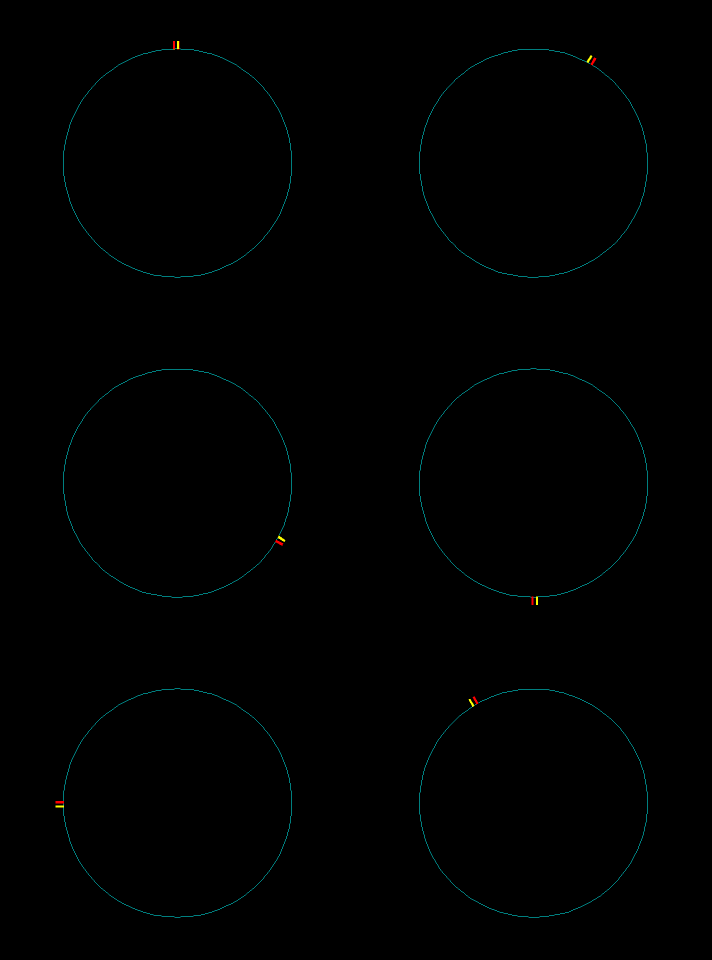 |
The wheel of life emulates the spinning Earth, cycling endlessly through day and night. The diagram at left shows the movement of you and I standing together on the surface of the Earth. To each other, we seem to be standing absolutely still with the sun moving across the sky overhead. In actuality, we are moving towards the east at 1,448 km/hr (about 900 nautical miles per hour) as the planet spins. When the planet completes a 24 hour rotation, we will not have returned to the same "place" at all because the Earth is also moving at an even faster pace in orbit around the Sun. |
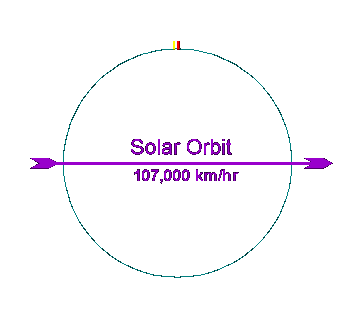 |
When the solar orbit is considered, our motion gets complex. The earth's spin is transformed by its orbital movement into a sine-wave through space. A single 24 hour day will see us some 2.6 million kilometers further along on our voyage around the sun oscillating in a very peculiar trajectory. |
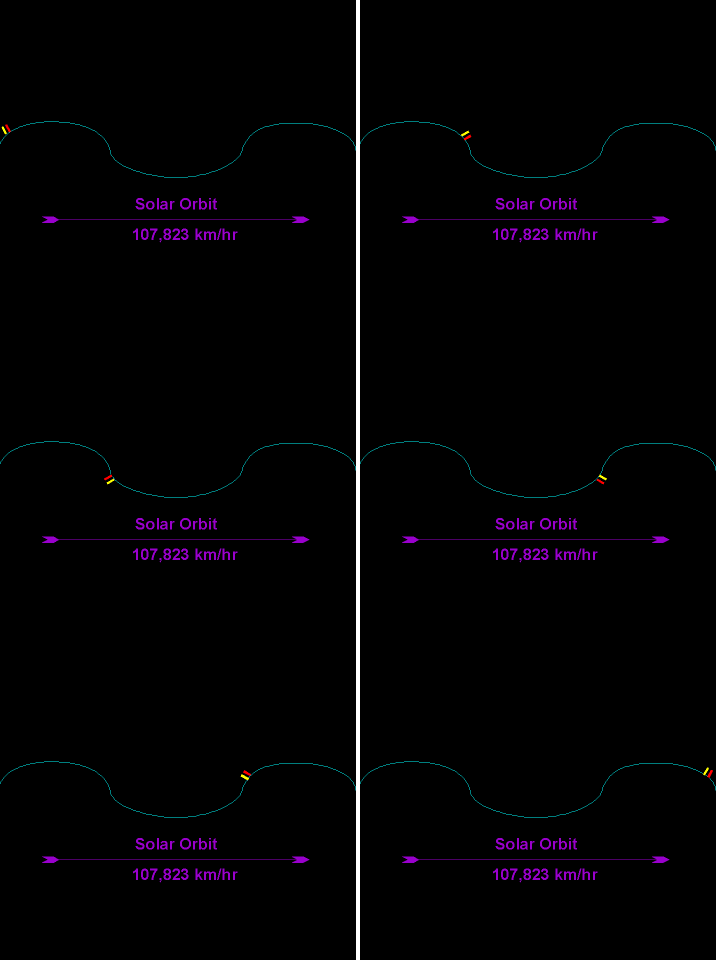 |
You and I change our relative positions as the planet rotates along its solar orbit. When we are on the side of the planet in line with the trajectory around the sun, we are both zooming along head first around the sun. When are on the sun side of the planet, our orbital velocity is 2,896 km/hr less than when we are on the dark side because of the spin of the planet. The red one of us leads the chase round the sun during the day, the yellow one of us leads during the night. Neither of us is aware of the inflection point where we make this change. |
|

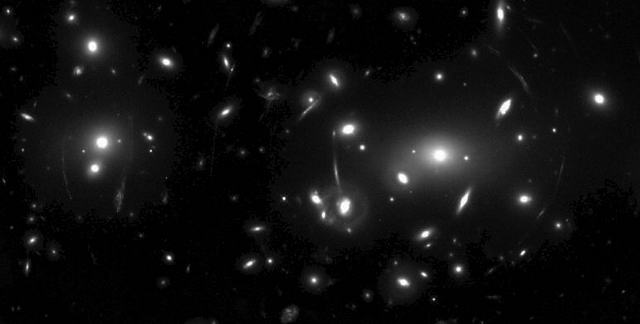
We are also moving, along with the sun, around the center of the galaxy at nearly a million km/hr. We orbit the galactic center once every 220 million terrestrial years making Earth about 21 galactic years old. But we don't come back to the same place because the galaxy is moving apart from the other galaxies at 2.15 million km/hr, which is close to the square root of the speed of light.
|

On the other end of the size scale, atoms also move at high velocities. Their speed changes as they heat and cool in the day and night of our planet, as they react with other atoms and as they enter and leave living systems.
The parts of the atoms
move even faster than the atoms. At the level of subatomic particles, the rapid movement
of all matter through space has critical implications.
Each kind of creature, and each layer of being, has its own ability to detect motion. We can only directly perceive changes when they happen within certain intervals.
We can, if we concentrate, directly observe the earth spinning, especially at dawn and dusk when the sun is revealed or eclipsed by the rotation of the planet. But we can't perceive the movement of the planet around the sun or the motions of atoms. We can measure these motions using scientific methods, and although we can't see them with our biological sensory capabilities, we know for an absolute fact that the movements are there and nothing ever returns to the same location twice.
No cycle can ever complete itself without an element of change.
This turns out to be a critical concept and requires an understanding of closed and open systems.
Closed Systems
From the perspective of the individual system, cycles do exist. The Earth does spin neatly on its axis and from the planetary perspective, points on earth return to the same RELATIVE position each day. We will call this a closed system cycle. A bicycle is a closed system and the tires, gears, and pedals rotate very exactly back to the same position relative to the bicycle itself. If you pump the pedals of your bike your feet will move in a cycle relative to you, always coming back to the same place.
Open Systems
All closed systems exist within open systems where the cycles look quite different. The points on the surface of our planet never return to the same place again relative to the intergalactic fabric of space.
When you use a bike, a point on the tire describes an up and down sine-wave relative to a road, and never returns to the same place on the road. Your feet on the pedals are always moving forward relative to the road, and their trajectory is also a sine wave, not a circular cycle.
Open systems are both larger and smaller than closed systems. For you on the bike, the road and the clouds are open systems. The atoms flow through you, racing along their own open pathways.
Surprise
Cycles of closed systems always fail to meet expectations because they are created within a network of open, non-linear, flowing systems. When the expected cycles fail, awareness emerges.
