
- Log of the Moira
- Finding the Thread
- Cruising Asia
- Cruising the Solomon Islands
- Cruising Australia Part 1
- Cruising Papua New Guinea
- Pearls, Pearls, Pearls
- What Am I Doing Here?
- Black, White and Grey in Paradise
- Dubious Mission to Tagula
- Words Appart
- Rascals in Paradise
- Pearl Diving in Doga Sui Sui Pass
- American Spies
- The Giant Man Eating Octopus
- The Great Ebony Caper
- The Uplift Factor
- Planned Failure
- A Tangled Web
- Opposition
- Midnight Sun
- Lapi in the Isles of Love
- Unchartered Waters
- Unnamed Island
- The Isles of Love
- Earthlings
- Nothing Atoll
- Super-Organisms in Time Lapse
- People of the Sea
- Coral Fires Burning
- Symbiotic Coral Megabeasts
- Symbiosis
- A Handy Experiment
- Destiny in Action
- Keops and Kaleidoscopes
- Poisoned and Dying in Sidea
- Dire Straits
- PNG Update
- Cruising Australia Part 2
- Ancient Respected Oracle
- Eye of the Dolphin
- Sydney Dolphin Cult
- Water Wings
- Sydney Dolphin Connection
- Sydney's Dolphinarium
- Dolphin communication
- Starlight Starbright
- Captive Dolphins
- Politics of dolphin liberation
- Sun Heralds Sydney Dolphins
- 40 foot swimming pool
- Media Dolphin Campaign
- Government Goo
- Dolphins in captivity
- Dolphin Referendum
- Australian Media Campaign
- Dolphins to die
- Orcas Visit Moira
- Dolphin Update
- Man and Dolphin
- Cruising New Caledonia
- Cruising Fiji
- Cruising Samoa
- This Magic Sea
- We are
- Awareness
- Learning
- We Voyage This Magic Sea
- Bound for Knowledge
- Beyond Perceptual Horizons
- Facts of Life
- Intercommunications
- Sea's Communication Webs
- Appearing
- 4 Phase Process of Becoming
- Thread of Awareness
- Error of Expectations
- Change of Expectations
- Mind
- Learning
- Fields of Perception
- Guides
- Tides
- Thread of Awareness
- Contact The Moira
E-BOOK VERSIONS
Enjoy these adventures on your ebook reader and help support the Thread of Awareness network of websites by downloading the Log of The Moira ebooks in epub and mobi formats for €5 per ebook or €10 for all three ebooks.


The Complete Series of all three ebooks.
For your mermaid.

The Unexpected
Our constant change in relative position creates error in expected cycles.
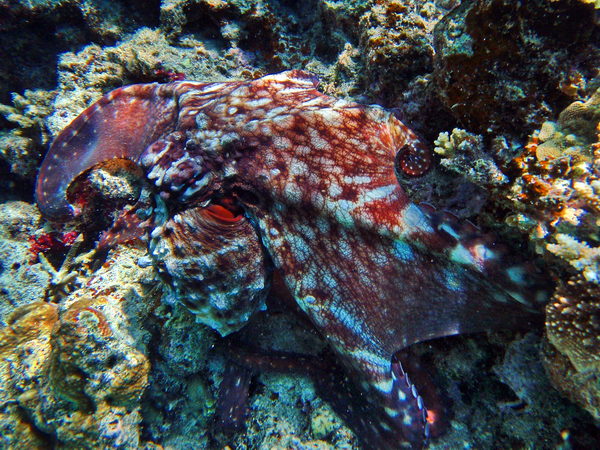
Snorkeling over the coral reef, I see a vista of seemingly
unmoving, unchanging corals. Starfish and sea cucumbers sit motionless on the bottom. Fish glide or hover or dash here and there. The brightly colored fish attract my attention as they glitter in the sun. Suddenly, my head turns, my eyes focus together on a single dead coral head. Even though I was not looking directly at it before - had not been aware of that particular section of the sea floor - some part of my mind was alerted. I know, after the event, I saw the dead coral rock move slightly. Dead coral rocks do not move.
I swim closer and dive down. The rock looks like a rock. I reach out to touch it and part of the rock moves again, sliding away from me. My mind refocuses and I see an octopus. It's skin has taken on the color and texture of the dead coral. Even though I am only a meter from it, it is still difficult to sort out the boundaries of the octopus. They are very good at disguise.
If
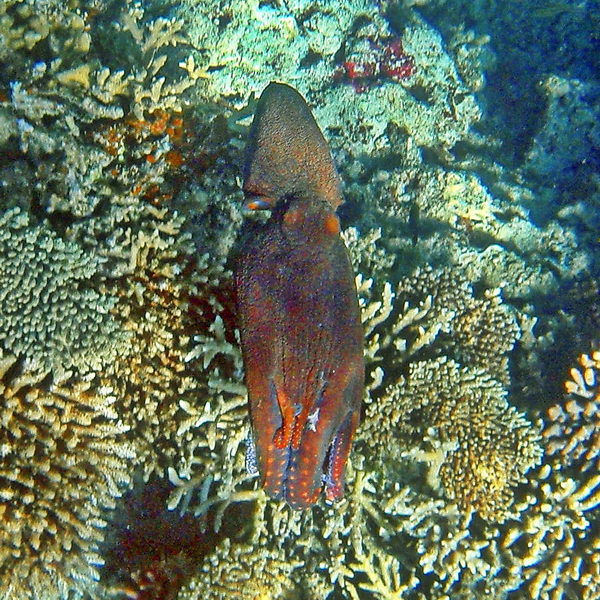
the octopus had not moved, I would not have been aware
of it. My mind had already formed an image of the coral reef and set up certain
expectations my conscious mind was totally unaware of. Even though I was swimming, even though my eyes were moving both along the trajectory of my body and sliding back and forth over the whole vista of the reef, the mental image showed a still-life image of unmoving corals and dead coral rock sprinkled with sudden, bright movements of reef fish and the random prismatic ripples of sunlight on the sea floor.
Can you find the octopus in this image?
Scroll around and have a look (use the full screen mode to search better.}
Although the diving mask restricted my normal vision slightly, I could still see a large area of the reef. The amount of information reaching the retina of my eyes was staggering. From the view of the millions of little cells forming my retina, there was a constantly shifting array of colors and shifting light intensities.
A single retina cell will sit quietly with its fellow retina cells until it detects a change. Some have been pre-set to send off a message to the brain when there is a shift in light frequency (a change in color) and others are pre-set to send of a message when there is a change in light intensity (from light to dark). The cell does not react to a particular level of light or color, it reacts to the change of color or light intensity. If conditions remain below the trigger threshold (i.e. the change is very slow), the retina cell does not signal the brain and, of course, the mind does not become aware of a visual image. Until the cell signals, it might as well not be there as far as our awareness is concerned.
When it does signal, the committee of cells it communicates with receives the incoming information and compares it to the information from adjacent retina cells. The information passed along from the eye cell to the brain cell is the news of a difference, a change. The eye cell expects conditions will continue at a steady state. When the conditions change, this comes as a surprise to the eye cell. The change of light is perceived by a chemical reaction within the retina cell. The cell compares the altered chemical condition with its memory of the intensity of light just preceding the change. If the difference exceeds a certain level, the cell reacts by sending off an electrical pulse to the brain.
Change in Focus
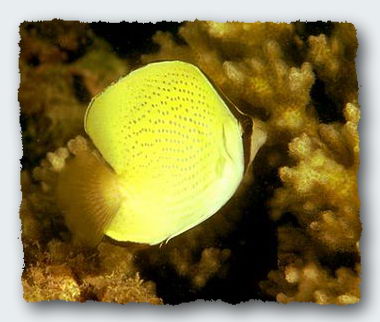
A Giant Trevally hunts for food in a school of glittering sardines. The sardines all look alike and move together in unison. The Trevally, faced with this wall of repeated shapes, can not react. But should one sardine be injured, or even momentarily distracted, it changes its behavior from the norm. It no longer follows the expected cycles of school movement. Other sardines, and the Trevally, becomes aware of it. The school of fish respond to the wayward individual and move away from it. The Trevally explodes forward and eats it.
Our own society does this, too. We all know what happens when an individual moves beyond the expected cycles of behavior.
The Change in Change
Awareness is the result of to be changing in a direction. Awareness is the message and the information contained in the message. It is the perceived and the perceiving. Systems oscillate and predict the cycle will return to the same place with each oscillation.
But nothing returns to the exactly the same place twice. It is impossible. Everything is moving through fields of radiation at a very high velocity. The dead coral rock, and its atoms, is moving at 900 knots towards the east as the planet spins on its axis. The planet is moving around the sun, the sun around the galactic center and the galaxy is moving at about the square root of the speed of light relative to the other galaxies. The same cosmic motion making randomness an illusion physically prevents any object repeating an exact cyclic trajectory.
Awareness is the offset from expected cycles, the change in change, the directionality in behavior of beings as they move throughout this continually changing magic sea.
