
- Log of the Moira
- Finding the Thread
- Cruising Asia
- Cruising the Solomon Islands
- Cruising Australia Part 1
- Cruising Papua New Guinea
- Pearls, Pearls, Pearls
- What Am I Doing Here?
- Black, White and Grey in Paradise
- Dubious Mission to Tagula
- Words Appart
- Rascals in Paradise
- Pearl Diving in Doga Sui Sui Pass
- American Spies
- The Giant Man Eating Octopus
- The Great Ebony Caper
- The Uplift Factor
- Planned Failure
- A Tangled Web
- Opposition
- Midnight Sun
- Lapi in the Isles of Love
- Unchartered Waters
- Unnamed Island
- The Isles of Love
- Earthlings
- Nothing Atoll
- Super-Organisms in Time Lapse
- People of the Sea
- Coral Fires Burning
- Symbiotic Coral Megabeasts
- Symbiosis
- A Handy Experiment
- Destiny in Action
- Keops and Kaleidoscopes
- Poisoned and Dying in Sidea
- Dire Straits
- PNG Update
- Cruising Australia Part 2
- Ancient Respected Oracle
- Eye of the Dolphin
- Sydney Dolphin Cult
- Water Wings
- Sydney Dolphin Connection
- Sydney's Dolphinarium
- Dolphin communication
- Starlight Starbright
- Captive Dolphins
- Politics of dolphin liberation
- Sun Heralds Sydney Dolphins
- 40 foot swimming pool
- Media Dolphin Campaign
- Government Goo
- Dolphins in captivity
- Dolphin Referendum
- Australian Media Campaign
- Dolphins to die
- Orcas Visit Moira
- Dolphin Update
- Man and Dolphin
- Cruising New Caledonia
- Cruising Fiji
- Cruising Samoa
- This Magic Sea
- We are
- Awareness
- Learning
- We Voyage This Magic Sea
- Bound for Knowledge
- Beyond Perceptual Horizons
- Facts of Life
- Intercommunications
- Sea's Communication Webs
- Appearing
- 4 Phase Process of Becoming
- Thread of Awareness
- Error of Expectations
- Change of Expectations
- Mind
- Learning
- Fields of Perception
- Guides
- Tides
- Thread of Awareness
- Contact The Moira
E-BOOK VERSIONS
Enjoy these adventures on your ebook reader and help support the Thread of Awareness network of websites by downloading the Log of The Moira ebooks in epub and mobi formats for €5 per ebook or €10 for all three ebooks.

The Complete Series of all three ebooks.
Patterns of Awareness who Guide Us
Communications create, and are created by, patterns of awareness who guide us.
 Concepts
exist embedded in networks
of communications that create them and are
created by them.
Concepts
exist embedded in networks
of communications that create them and are
created by them.
They act within the parameters set by these networks. The network parameters depend on the horizons of perceptions of the beings within them. Beings with the most distant horizons of perception act as guides to determine the behavioral possibilities of whole ecosystems, but the guides must perceive and react within the existing network of behavior, creating new patterns of behavior through a process of slowly modifying their own perception, memory and response.
Behavior guides for any single being are woven by the myriad capabilities of the other concepts creating the flow of information through the web of communications. An Octopus is able to roam freely through a coral environment and, in selecting its prey and constructing its burrow, alters the distribution of organisms on the reef and even growth patterns of the coral. But the behavior of an octopus depends on the behavior of corals that construct the terrain through which the octopus moves and in which the octopus concept has evolved over millions of years.
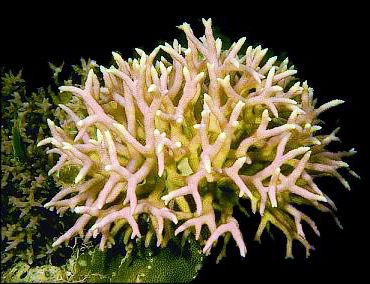
A coral colony, like all living systems, is a communication web made visible by the activities of the coral. Carbon, oxygen and calcium molecules, taken from the sea water by the coral cells are used for a variety of biochemical needs and then some of these are forced out of the cell membranes to form a crystal skeleton under the coral flesh. The combined communications of the coral cells, integrated by the genetic memories and timed by environmental stimuli, results in the specific structure of the skeleton.
The skeleton, attached to the sea floor, extends up into the sea, recording the coral's behavior moment by moment. It's delicate design resembles a fractal image because it is a fractal image, a set of specific relationships solved again and again by the intercommunications of perception, memory and reaction.
Like a fractal image built by the constant shift in position of points mapped in imagined space, the coral skeleton appears as each molecule of calcium carbonate, crystallized by the coral behavior, occupies a slightly different position than the one before it. The pattern emerges in an intricate design as beautiful as a snowflake, but as permanent as a rock.
The skeleton is a record of past behavior of the coral and all the other creatures associated with the growing coral colony. The existence of the skeleton alters the future of the reef in its vicinity. It changes how the nested layers of living molecules, cells, tissues, polyps, colony, ecosystem behave. All aspects of the coral colony are controlled by the lasting, cumulative effect of its previous behavior.
The coral colonies communicate with each other and with other beings (fish, mollusks, algae, echinoderms, etc) to form coral reefs. The reefs interact with the sea, land, and atmosphere to form larger structures, like atolls. The structure of the atoll exists as the combined behavior web of all the various coral reef plants and animals. Its passes, surf zones, lagoon, islands and other structures are created by the reef creatures over millions of years, and these structures then control the environment for the individual reef creatures - forcing them to exist in certain areas and behave in specific ways.
The feedback system weaving through the nested layers of communications guides each successive series of perception, memory and response. This recursive system of information flow is itself linked to controls based on the capabilities and characteristics of each layer of the network. The result is recurring patterns of structure and behavior that act as controls.

Finite control systems limit the infinite diversity of life. The patterns of possible development, fascinated D'Arcy Thompson. His classic book, On Growth and Form, described how forces limited the shape and function of living systems. These controls fascinated scientists at the end of 19th century and the start of the 20th Century. They were described as "physical forces" or ideal forces emanating, perhaps, from Plato's Ideal dimension. Later scientists, like Rene Thom, studied the mathematics of control systems as limitations in possible behavior of systems. Now, using the math of complexity (fractals) scientists are beginning to realize the curious lack of random, chaotic behavior in complex systems. Patterns develop where no patterns should be, and they are strikingly beautiful. Hauntingly familiar.
Controls operate on patterns of organization on different levels in the nested layers of intercommunications.
At each level, there are control systems specific to that level, altering the behavior of the beings creating it. These controls change the structure of the entire system on levels extending from the atomic to the ecosystem.
The basic control system is this:
-
Communications of beings create a larger organization. The envelope of perception-memory-response abilities of the beings creating the organization determine the complexity and collective abilities for the organization they construct.
-
The larger communication web then uses its complexity and abilities to guide its members in future communications - establishing how and when they can use their abilities to perceive, remember and respond.
-
The larger behavior patterns - the organizations - exist over longer intervals than the individual constituents and exerts guidance control over the shorter lived behavior patterns.
The basic pattern of control is evident everywhere. An easily understood example from human affairs is a corporation.
-
A corporation, forms (appears historically and appears moment by moment) by the intercommunications (the connections, communications, and information exchange) of individual human beings. The envelope of abilities of the people creating the corporation determine the complexity and collective ability of the corporation to conduct business.
-
Once established and operating, the corporation then guides the behavior of individual human beings. It extends a control network over the communications, dictating where employees will be on a day to day basis and what they will be doing with their bodies and minds. Employees are given a persona, an act to perform, and often a title to replace the normal human name when dealing with formal corporate matters. The corporate charter and regulations comprise written guidelines for behavior ("The chair recognizes the president.").
-
Corporations control the behavior of more than its shareholders, executives and employees. They also influence the behavior of others who work in any way for the corporation, benefit from its products or services or are harmed by the corporation or its products (customers, taxation departments, suppliers, competitors, plants and animals). Companies making automobiles, for example, have altered the behavior patterns of nearly everyone, and many ecosystems, on the planet.
-
A business corporation is, in turn, guided in its behavior by national and international control systems - legal, economic, and political. If successful, the corporation grows, expands, and learns new behavior - expanding its control over more and more people.
-
Corporations can live longer than the people who create or work for them. Large organizations exert guidance (controls) over thousands, millions, or even billions of people. People are born, grow old and die within the guidance envelope of large corporations.
We could substitute any communication network, being, concept, or entity for "corporation" in the steps outlined above. Nation would work, or team or family or species or multicellular creature or even a cell, made up by the behavior of billions of molecules.
From time to time, control systems become obvious when they malfunction. One classic example is the Crown of Thorns Starfish Explosion in the Tropical Pacific.
