
- Log of the Moira
- Finding the Thread
- Cruising Asia
- Cruising the Solomon Islands
- Cruising Australia Part 1
- Cruising Papua New Guinea
- Pearls, Pearls, Pearls
- What Am I Doing Here?
- Black, White and Grey in Paradise
- Dubious Mission to Tagula
- Words Appart
- Rascals in Paradise
- Pearl Diving in Doga Sui Sui Pass
- American Spies
- The Giant Man Eating Octopus
- The Great Ebony Caper
- The Uplift Factor
- Planned Failure
- A Tangled Web
- Opposition
- Midnight Sun
- Lapi in the Isles of Love
- Unchartered Waters
- Unnamed Island
- The Isles of Love
- Earthlings
- Nothing Atoll
- Super-Organisms in Time Lapse
- People of the Sea
- Coral Fires Burning
- Symbiotic Coral Megabeasts
- Symbiosis
- A Handy Experiment
- Destiny in Action
- Keops and Kaleidoscopes
- Poisoned and Dying in Sidea
- Dire Straits
- PNG Update
- Cruising Australia Part 2
- Ancient Respected Oracle
- Eye of the Dolphin
- Sydney Dolphin Cult
- Water Wings
- Sydney Dolphin Connection
- Sydney's Dolphinarium
- Dolphin communication
- Starlight Starbright
- Captive Dolphins
- Politics of dolphin liberation
- Sun Heralds Sydney Dolphins
- 40 foot swimming pool
- Media Dolphin Campaign
- Government Goo
- Dolphins in captivity
- Dolphin Referendum
- Australian Media Campaign
- Dolphins to die
- Orcas Visit Moira
- Dolphin Update
- Man and Dolphin
- Cruising New Caledonia
- Cruising Fiji
- Cruising Samoa
- This Magic Sea
- We are
- Awareness
- Learning
- We Voyage This Magic Sea
- Bound for Knowledge
- Beyond Perceptual Horizons
- Facts of Life
- Intercommunications
- Sea's Communication Webs
- Appearing
- 4 Phase Process of Becoming
- Thread of Awareness
- Error of Expectations
- Change of Expectations
- Mind
- Learning
- Fields of Perception
- Guides
- Tides
- Thread of Awareness
- Contact The Moira
E-BOOK VERSIONS
Enjoy these adventures on your ebook reader and help support the Thread of Awareness network of websites by downloading the Log of The Moira ebooks in epub and mobi formats for €5 per ebook or €10 for all three ebooks.


The Complete Series of all three ebooks.
Memory
We are a crystal memory in a Magic Sea
 .
.
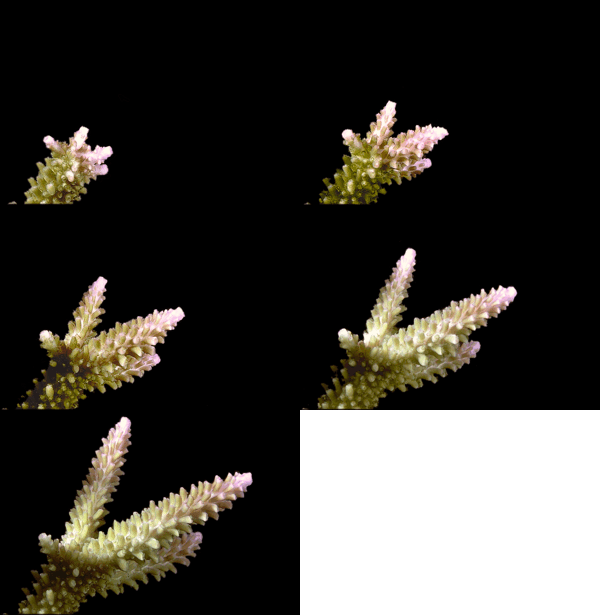
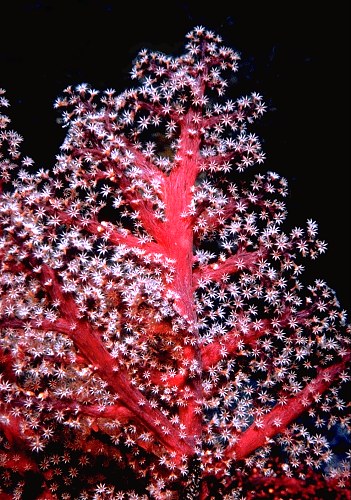
The flow of communications between each atom, every cell, every creature, leaves a wake. For corals and many other animals, the wake takes the form of a skeleton, made of molecules of calcium carbonate. For plants, the wake is solidified with cellulose. The skeleton is a crystal memory, revealing years of perceptions, memories and responses.
Perception-memory-response is a flow of communications through the focus of a being. Perceptions and memories are mirror images of each other, reflected flows of streaming information, selectively regulating the process of becoming. These streams not only create a skeletal wake, they project a bow wave of momentum.
The wake and the bow wave of the streams of communications establish a trajectory the participants must follow. These trajectories are the visible boundaries of life, the interfaces of perception, memory and response we perceive as living entities.
Before the evolution of mind, memory existed as momentum and conservation of energy. The trajectory of an arrow in flight, for example, carries a "memory" of the bow and even of the archer's aim.
In living systems, memory is communication momentum. At each level - molecular, cellular, multicellular - the composite beings expect the existing movement of energy and information to follow a pre-established pattern. The pattern of expectation is an accumulation of all of the past experiences of that being - about 3.6 billion years of experiences.
Memory, A dynamic position
Memory, like perception, threads through a living system, balanced on the shifts and movements in the flow of information.
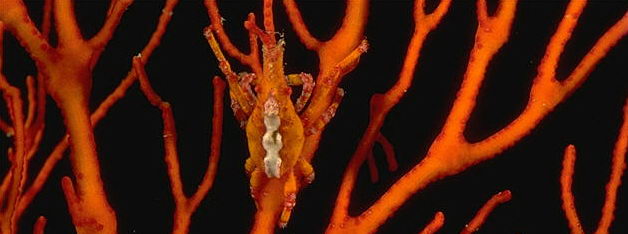
The small crab hiding on a sea fan is an accumulated set of conditions and communications threading through the entire web of relationships between the sea fan, the crab and its predators. All members of the association rely on the existing structural relationships to assess the ongoing stream of perceptions and responses.
Our memories are also based on structural relationships. If you can remember the image, now that it is off screen, it is because the perception was encoded in a specific set of molecular bonds within your neurons. Your memory is a structural event, a structure created by and with intercommunications threading through the entire web of relationships existing between all the layers of your being, from atoms to as far as your perception and your imagination can reach.
Just as the crab has a dynamic structure and position on the sea fan, the molecules of memory have a dynamic structure and occupy a special position in the web of communications of your brain.
The pattern of information flow, regulated by the atomic bonds of these molecules, changes in response to your perceptions. By repetition or by importance, the new molecular condition becomes increasingly permanent. New protein structures, imprinted with former perceptions, crystalize within the cytoplasm of the neuron, attached like threads to the mysterious golgi apparatus. The threads of memory get longer and more numerous as we encode more information. Each thread holds fast to the skeletal protein web of your neurons like tiny crabs who have found just the right place in life.
Shaping Memory
Our memories are personal, intimate, often hidden even from ourselves.
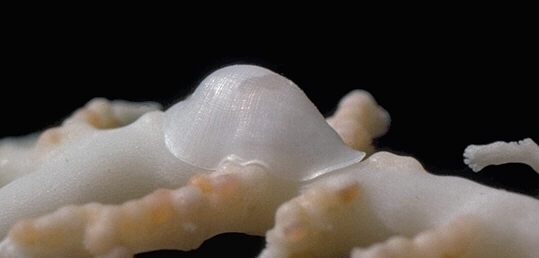
Each experience shapes the molecular web of communications and this, in turn, shapes our physical form. A good example of this is a tiny sea snail who lives on the porcelain coral Stylaster in the deep water of China Straits, in Papua New Guinea. It moves about at night to graze, but returns to exactly the same place on the coral each morning. Its shell molds itself perfectly to the coral because the snail holds on tight when tidal currents run fast in the China Straits. Cells on the edge of the creature's mantle lay down the crystal pattern of the shell in tiny daily increments, the shape of the shell reflecting the habitual movement of the mantle between the sea snail and the coral. The shape of the coral recorded in the shape of the snail's shell, helps it recall where it belongs in the world and keeps it safe. A perception frozen into memory in the white crystal of the shell.
Like the shell settling into position on it's special perch, the web of intercommunications between molecules and between cells, examines the stream of information to re-perceive prior perceptions. The molecules holding the template of prior perceptions are in a continual state of flux with atomic elements flowing rapidly through them. When a new flood of information matches with the preexisting template, the cells and our mind recognizes (re-knows) the flow.

If there is a change between our expectations and the new flood of perceptions, the difference between the old perception and the new one determines how we will respond. The comparison of the incoming flood of analog perceptions with prior perceptions results in the conversion of the analogue field of information into a digital choice. Do the incoming signals get through the web of memory (they are as expected and thus ignored) or not (they are a surprise)? Yes or No. Respond or Not.
Awareness only exists when there is a pre-set memory of the existing status. Detecting change requires some method of maintaining a no-response state within set limits. The more sophisticated the system for holding prior status information, the greater the ability to detect changes from previous conditions. Some of these are short-lived, like the memory of a retinal cell of pre-existing light intensity (stare at a bright light source then close your eyes and you see the retinal cell memory of the light that fades quickly). Others are long-lived imprints of a condition that may have been imprinted on the whole system days, weeks, or years in the past.
Memories accumulate. They are the change in change, the residue of change. Learning is memory. DNA is memory. Memory gives directionality to awareness and enables To Be To Change in a favorable direction and thus survive.
Genetic Memory
The genetic code, is a memory set of patterns of communications perceived over billions of years. A cell's perception of incoming information triggers the release of information from the ancient memories. The release is a response, one that has always, in the past, promoted survival. In short, the cell does what it did before to stay alive. The cell, every cell, remembers information that is millions upon millions of years old because they are all billions of years old.
The responses are not simply producing new proteins or other chemicals, but include clear perceptions of how to use these proteins to move from one part of the body to another, changing form and function, until the hundred trillion cells move into position and form and motion that is a coral. Or you. The memories are there, too, for how to operate the galaxy of cells to snare a microscopic plankton from the sea. Or in your case, how to suckle, cry, move your eyes, legs, arms, grow up, learn to speak and whatever else you need to become a human being.
Genes are memories relived, memories learned through billions of years of living. The crystalline spirals of DNA emit their memories to the whole association of beings - from atoms to ecosystems - when the memories are transcribed by awareness.
Shorter memories, those we have in our multicellular life, are not stored in the reproductive DNA. Or so the story goes, I'm not entirely convinced. When we perceive our environment, the whole communication web of our cells constantly assesses the flow of information against prior conditions.
Most of the inflow of information is of no interest whatever to the conscious mind and the vast majority of our perceptions and responses are filtered out. The limits of these filters are set by our current status. If information varies beyond these set limits, it penetrates higher into the system. It gets "louder" and the organism responds at the required level to adjust the level back towards the desired level again.
Some very strange things happen with Memory.
