
- Log of the Moira
- Finding the Thread
- Cruising Asia
- Cruising the Solomon Islands
- Cruising Australia Part 1
- Cruising Papua New Guinea
- Pearls, Pearls, Pearls
- What Am I Doing Here?
- Black, White and Grey in Paradise
- Dubious Mission to Tagula
- Words Appart
- Rascals in Paradise
- Pearl Diving in Doga Sui Sui Pass
- American Spies
- The Giant Man Eating Octopus
- The Great Ebony Caper
- The Uplift Factor
- Planned Failure
- A Tangled Web
- Opposition
- Midnight Sun
- Lapi in the Isles of Love
- Unchartered Waters
- Unnamed Island
- The Isles of Love
- Earthlings
- Nothing Atoll
- Super-Organisms in Time Lapse
- People of the Sea
- Coral Fires Burning
- Symbiotic Coral Megabeasts
- Symbiosis
- A Handy Experiment
- Destiny in Action
- Keops and Kaleidoscopes
- Poisoned and Dying in Sidea
- Dire Straits
- PNG Update
- Cruising Australia Part 2
- Ancient Respected Oracle
- Eye of the Dolphin
- Sydney Dolphin Cult
- Water Wings
- Sydney Dolphin Connection
- Sydney's Dolphinarium
- Dolphin communication
- Starlight Starbright
- Captive Dolphins
- Politics of dolphin liberation
- Sun Heralds Sydney Dolphins
- 40 foot swimming pool
- Media Dolphin Campaign
- Government Goo
- Dolphins in captivity
- Dolphin Referendum
- Australian Media Campaign
- Dolphins to die
- Orcas Visit Moira
- Dolphin Update
- Man and Dolphin
- Cruising New Caledonia
- Cruising Fiji
- Cruising Samoa
- This Magic Sea
- We are
- Awareness
- Learning
- We Voyage This Magic Sea
- Bound for Knowledge
- Beyond Perceptual Horizons
- Facts of Life
- Intercommunications
- Sea's Communication Webs
- Appearing
- 4 Phase Process of Becoming
- Thread of Awareness
- Error of Expectations
- Change of Expectations
- Mind
- Learning
- Fields of Perception
- Guides
- Tides
- Thread of Awareness
- Contact The Moira
E-BOOK VERSIONS
Enjoy these adventures on your ebook reader and help support the Thread of Awareness network of websites by downloading the Log of The Moira ebooks in epub and mobi formats for €5 per ebook or €10 for all three ebooks.


The Complete Series of all three ebooks.
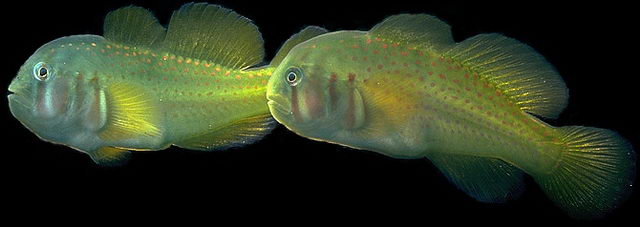
Consciousness is communication between concepts existing within the same interval of awareness.
Awareness is communication between a being and itself at the start and end of an interval.
Consciousness is communication between concepts existing within the same interval of awareness.
Awareness emerges as the closed communication system of a being with itself is surprised by the open communication systems that surround and move through it.
Communications between large numbers of different beings generates a new level of awareness.
Living (organic) molecules communicate with each other via electromagnetic fields, shapes and movements. Their communications happen in nanno-seconds and form associations that may last for microseconds or for years. Although some organic molecules can form and reform in non-living environments, complex molecules like DNA and RNA only are formed by communication webs existing between thousands of different kinds of living molecules swapping messages between billions of individual living molecules. The molecular communication web manifests itself as a bacterium.
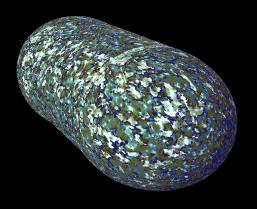
Communications between living molecules create the emergence of an aware bacterium. Bacteria communicate, too.
Bacterial communications are different from the kinds of communications that go on between the molecules creating the bacteria.
Bacteria use some of their living molecules to communicate with other bacteria, or the more complex organisms that they form associations with.
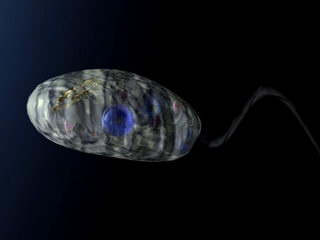 Intercommunications between certain kinds of bacteria result in the moment to moment appearance and the
awareness of the creature we call a cell. Bacterial communications regulate the
cell's internal state and its responses to the environment.
Intercommunications between certain kinds of bacteria result in the moment to moment appearance and the
awareness of the creature we call a cell. Bacterial communications regulate the
cell's internal state and its responses to the environment.
Cells also communicate, and cellular communications, and especially their meanings, are different from the molecular and bacterial communications.
Cellular signals guide cells to move in specific ways, occupy specific positions, and respond in set ways to a wide range of environmental conditions.
Communications between cells create the appearance and awareness of multicellular creatures, including all plants and animals.
Human Communications
Cellular communications (chemical, electronic, microwave) manifest our bodies, our perceptions, our memories, our responses and our minds. Although cellular communications move our muscles and larynx to speak or write words, the words we speak are entirely different from cellular signals.
Communications between people create an entirely different web of communications, a language mind that guides people to place them in specific positions, doing specific actions, on a moment to moment basis. This communication web manifests our houses, cities, and all aspects of every human enterprise - technical or spiritual. Language creates a larger entity known as mankind or, more simply, Man.
 The word Man comes from the Indo-European root men = to think, also seen in the Latin word mens = mind, and translates as the one who thinks. The one who thinks is not the individual human, nor the cells of the human, nor its bacteria or molecules.
Man is human consciousness - knowing together - created by the intercommunications between and within individual humans.
Conscious comes from the Latin com = with or together, and scire = to know. Modern use of the word encompasses all aspects of mental activity, from awareness to mind. It is a contentious word, almost as if we have agreed to disagree about its meaning.
Animals are aware, we say, but only humans have consciousness, or self-consciousness. We are very possessive about our consciousness.
We also have sub-conscious or un-conscious minds. From time to time we experience altered states of consciousness, or higher states of consciousness. There are trance states where we are not conscious and there are states of numb awareness without consciousness.
Our conscious mind, even in altered states, is created and influenced by other levels of mind we are not conscious of. Our conscious mind, for example, has no knowledge of how our own mind forms words or transforms thoughts into letters appearing on a page or letters on a page into thoughts.
Our conscious mind does not know how our eyes function or how the signals from the eyes are metamorphosed into a world image. Scientists and philosophers have fought with each other and themselves for over a thousand years about the elusive link of the mind and the physical brain. Click here to solve this paradox.
The conscious mind is like a news commentator, sitting proudly in a glass box, reading a script about the outside world to other listeners. The commentator does not gather the news or make the broadcast station or fabricate the electronic components. The news commentator is a communicator for a much larger communication web.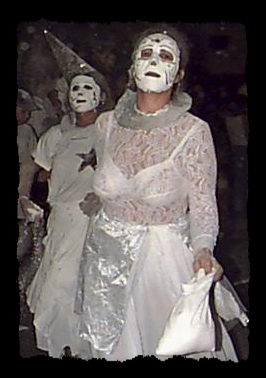 The original meaning of the word person was per = through and sona = sound. Persona described the face masks used by actors in the early days of theater, the ones actors spoke through to hide their true identities and allow them to become special beings for the audience. Later the word person became used for the mask we humans wear in society to shield our animal selves from others (and even ourselves). Person is now synonymous with human being. Our personality is a measure of how we fit into the social communication web.
Human personas are extremely important in the organization of society. We are workers or priests or presidents or doctors or husbands or wives or sons or daughters, and we play these roles according to set rules - some written (job descriptions), some unwritten (family relations). All of the roles, however, are defined by words and associated communications between each other. We have individual names and these are held sacred. We are told in words how to behave properly for whatever role we select or society selects for us. Words control every aspect of human life, they are how we know together. Language is human consciousness, and it is totally and undeniably different from the fields of intercommunication of any other life form.
The original definition of consciousness - to know together - also applies to the binding together of any population of creatures into larger units of being.
The intercommunications between beings existing at the same interval of awareness are what these beings know together, it is their consciousness, and consciousness creates the next larger integration of being. This sequence forms the core of the basic control system enabling life.
