
- Log of the Moira
- Finding the Thread
- Cruising Asia
- Cruising the Solomon Islands
- Cruising Australia Part 1
- Cruising Papua New Guinea
- Pearls, Pearls, Pearls
- What Am I Doing Here?
- Black, White and Grey in Paradise
- Dubious Mission to Tagula
- Words Appart
- Rascals in Paradise
- Pearl Diving in Doga Sui Sui Pass
- American Spies
- The Giant Man Eating Octopus
- The Great Ebony Caper
- The Uplift Factor
- Planned Failure
- A Tangled Web
- Opposition
- Midnight Sun
- Lapi in the Isles of Love
- Unchartered Waters
- Unnamed Island
- The Isles of Love
- Earthlings
- Nothing Atoll
- Super-Organisms in Time Lapse
- People of the Sea
- Coral Fires Burning
- Symbiotic Coral Megabeasts
- Symbiosis
- A Handy Experiment
- Destiny in Action
- Keops and Kaleidoscopes
- Poisoned and Dying in Sidea
- Dire Straits
- PNG Update
- Cruising Australia Part 2
- Ancient Respected Oracle
- Eye of the Dolphin
- Sydney Dolphin Cult
- Water Wings
- Sydney Dolphin Connection
- Sydney's Dolphinarium
- Dolphin communication
- Starlight Starbright
- Captive Dolphins
- Politics of dolphin liberation
- Sun Heralds Sydney Dolphins
- 40 foot swimming pool
- Media Dolphin Campaign
- Government Goo
- Dolphins in captivity
- Dolphin Referendum
- Australian Media Campaign
- Dolphins to die
- Orcas Visit Moira
- Dolphin Update
- Man and Dolphin
- Cruising New Caledonia
- Cruising Fiji
- Cruising Samoa
- This Magic Sea
- We are
- Awareness
- Learning
- We Voyage This Magic Sea
- Bound for Knowledge
- Beyond Perceptual Horizons
- Facts of Life
- Intercommunications
- Sea's Communication Webs
- Appearing
- 4 Phase Process of Becoming
- Thread of Awareness
- Error of Expectations
- Change of Expectations
- Mind
- Learning
- Fields of Perception
- Guides
- Tides
- Thread of Awareness
- Contact The Moira
E-BOOK VERSIONS
Enjoy these adventures on your ebook reader and help support the Thread of Awareness network of websites by downloading the Log of The Moira ebooks in epub and mobi formats for €5 per ebook or €10 for all three ebooks.

The Complete Series of all three ebooks.
For your mermaid.
The Observer
 "But what," Dr. John Lilly asks me as we wind down Malibu
Road, "about The Observer?"
"But what," Dr. John Lilly asks me as we wind down Malibu
Road, "about The Observer?"
Dr. John Lilly began his career in cognition hammering electrodes into dolphin brains without anesthetic. John Lilly who, upon becoming objective about what he was doing, entered into a new mental space, shucked the hammer approach to psychic phenomena, and became a California Guru in the sparkling frontier of pure mind. I spent the entire morning talking with him about systems theory in biology.
And now, as he drives me back to my hotel, he wants to know about the observer.
"Don't forget the observer," he says meaningfully, sliding his eyes from the mountain road to mine and back again.
So many answers flare up that I don't reply at all. He might have just as well have asked about the Creator. When novice evolutionists look at the marvelous adaptations of beings they immediately think of the Creator who orchestrated all this unity in diversity, as if life lacks the knack of doing it by itself. All those dumb plants and animals. The Observer is another variation of the same polar belief system - the division between mind and matter, the created and the creator, the observed and the observer. Same thing.
Well, OK, it's hard to think otherwise. Our senses and a couple of thousand years of heavy duty philosophy have warped our concepts on this. Linguistic and logical sand traps are scattered everywhere on the mental playing field.
This does not mean there is no Observer or Creator. It means we don't recognize these for what they are.
Lilly was right. The observer is something we should not forget about. The first thing to remember is that there is no observer by itself.
Stuck into one of John Lilly's dark, warm, watery, quiet isolation chambers, without any tangible links to an "outside reality," the observer gets antsy and starts mentally zipping here and there trying to find out where the hell the world went to. Lilly and many other isonauts discover that the observer goes right into orbit and even warp drive, going where no - uh - person has ever gone before. Use Ketamine, Lilly said, a kid's anesthetic, to get the antigravity engines really humming.
I read somewhere that people who specialize in torture know all about this sort of thing. Leave the observer without anything to observe long enough and they get so far out they never come back - at least not to whatever they were before. It's easy, the article said, to make isonauts believe anything and agree to anything - the key to a successful torture session.
The observer is part of a process - without an observation there is no observer.
To be more exact, the observer is a feedback relationship between focal points (beings changing in a direction) and the larger systems these create and are created in.
If you did not reach this page progressively and that definition is totally confusing, hyperlink over to Torus and browse through till you understand that.
Nobody said changing basic viewpoints was supposed to be easy.
Observing the Observer
Observing the observer is kind of like hammering electrodes into dolphin brains to study their mental processes. Morally difficult and you wind up with confusing data that might not mean anything at all.
John had a special affinity with this Observer thing, as you can see if you read his book "The Eye of the Cyclone" (as in the observer is the eye of the cyclone which isn't really very far off). Part of his fascination came from having his own viewpoint going off without the cyclone, hyperlinking into cosmos to browse with alien beings. The observer gets pretty interested in itself when it realizes it does not seem to be confined to its position in the eye of the cyclone. Here, again, I invite you to link off to a discussion on the role of the vortex, if you don't follow this analogy.
John's problem was the actual "physical" location of the observer relative to what seems to be a perfectly ordinary human being. We do really have the odd capability, from time to time, of removing the point of observation from ourselves to see ourselves or our world from another viewpoint. If you have not had the experience I do recommend it, although not with the usual associated trauma that makes it happen spontaneously. (There are some non-traumatic exercises in the Thread of Awareness section of this CD).
We can, of course, correctly dismiss vagrant observers as pure imagination. I suppose cognitive scientists would now see this as part of John's extended self organizing process. It is, it is. But this answer kinds of begs the question a bit and it turns out that maybe it is an important bit.
The Observer's role in the 4 phase process of becoming
In the 4 phase process of becoming (a.k.a. autopoiesis),
1. Information, elements and energy flow in towards the center of a being,
2. The being alters its behavior based on a comparison of this influx with what it expected,
3. This change in behavior results in a redirection of information, elements, and energy streaming from the being.
4. The alteration in the flow of information, elements and energy results in a change in the surrounding relationships of information, elements, and energy.
I made that complicated on purpose and will make it even more complicated by giving a complicated example.
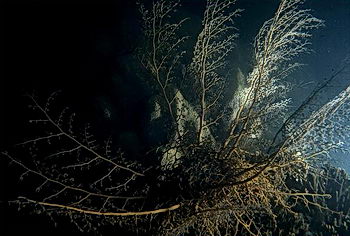
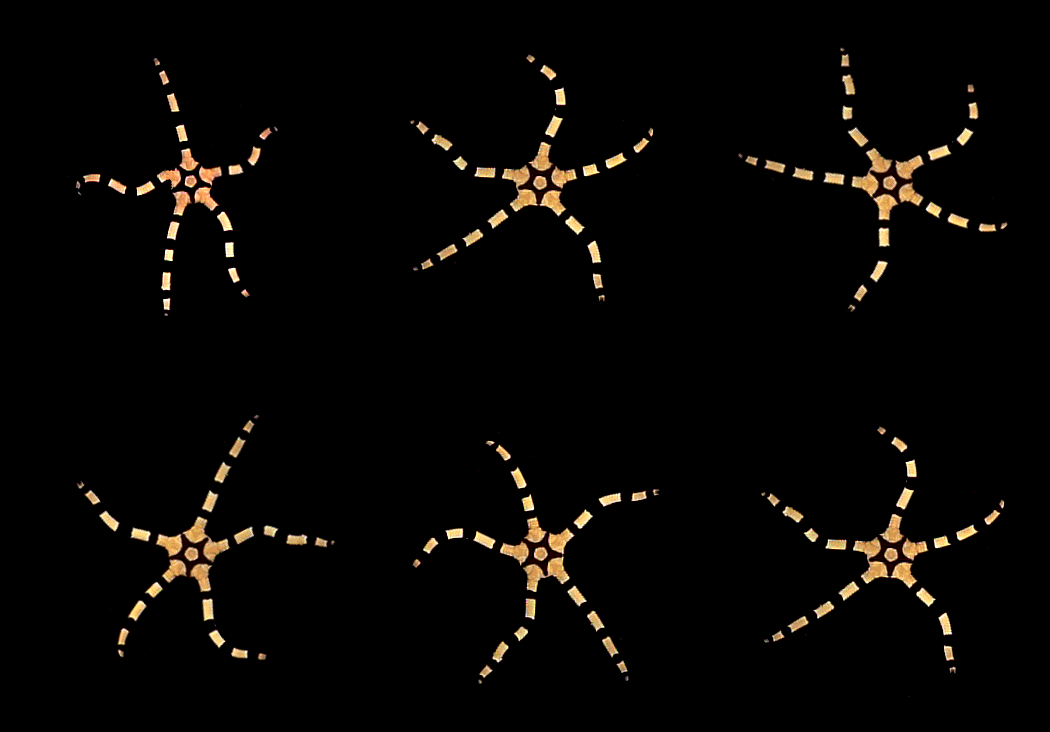
The Basket Star's Nightly Observations
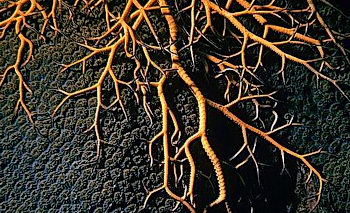
The basket star is a stellar example of a web-like flow of energy and information.
At night, it climbs up on a coral and unfurls its delicate arms out into the sea. The passing ocean current - containing elements, information and energy - flows through the net-like arms of the brittlestar.
Zooplankton (microscopic animals that swim in the sea) get snagged by the smallest arms of the basket star. When it catches something, the basket star must curl up that particular arm and stuff the wiggling morsel into its mouth, located in the midst of another batch of entangled arms. Very entertaining to watch, if you can keep your mind from thinking about the rest of the night sea behind you.
Locating the basket star's mouth amid all those arms is rather like trying to locate the observer. We can't very well say the basket star hasn't got one - an observer that is - as the critter is demonstrably aware and very talented (I'd like to see you try to transfer a struggling copepod from one of 5,657 fingers into your mouth). Even more difficult is working out how the creature manages to orchestrate setting its web into a nice big parabolic sieve. Or even climb up on the coral to start with. It hasn't got any eyes to verify where each little tentacle happens to be. How does it observe and where is the observer doing the observation?
The Basket Star Process
The basket star moves as a process, each movement results in changes in the creature's environment. Like, for example, the flow of water.
A tentacle extended at right angles to a current creates more turbulence than a tentacle pointed directly into a current. This increase in turbulence results in a transfer of energy to the arm segments closer to the disk of the starfish. The more turbulence, the more pressure. Maximum energy means maximum turbulence - and the net is set.
There is also balance. If one arm gets more energy than another, the creature's grasping arms must compensate while the net tentacles wiggle around to improve their turbulence.
-
The tentacle moves.
-
The flux of energy and elements in the ocean changes,
-
The starfish detects the ocean's response.
-
The perception of the ocean response is the inflow of information and energy in the creature's process of becoming (autopoietic process).
-
The organism compares the influx of information and energy with its memory of what life was like before it moved. The energy (turbulence), for example, has increased or it has decreased.
-
Based on this comparison the creature responds by signaling muscles in the tentacle to contract or relax.
-
It may be much of this is handled locally in each tentacle by neural feedback loops but the description fits the whole system even if the information about the ocean response does not go directly to the central disk -
-
At the end of the cycle, the central disk participates in the balancing act and - yum yum - the final reward.
-
-
Each new movement elicits a response by the surrounding system (in this case the ocean).
-
The creature detects this response and decides on the next action and this elicits a response by the surrounding system and the creature detects this response and decides on the next action.
The Error of Expectations
The creature's recognition of the change in the surrounding system is the error of expectation - or the news of a difference. This is awareness.
Awareness emerges to become a coherent, patterned property of an observer as intervals between the continual changes in the environment and the ongoing detection of differences from the previous expectations. (Maturana calls this structural coupling).
We can, for discussion, segment this process but in reality the observer - the whole basketstar - is an emergent quality within a continuous process.
Awareness and the Observer are polar reflections.
The response of the environment is one pole of awareness (outer) and the detection of the difference the other (inner) pole.
The observer and awareness are aligned along this polarity, with the observer at the inner end (where memories are stored) and awareness at the outer end (where differences are generated). Both poles are included in the closed system we recognize as the whole being, with sensory molecules and cells doing the detecting at the outer end and generating a flood of information to the central nexus of the system (brain, ganglia, nucleus).
This flood of information through patterns of living subsystems, creates something brand new and different - the observer.
The observer is one level of organization higher than the cellular flow of awareness information. It has an overall coordinating function. It does not exactly reside anywhere in particular within this process but does have a polarity relative to the incoming information.
The exercise of its role as coordinator means generating a flow of information outward from the observer to the muscles and associated subsystems, but the "observer" can just as easily "be" at the tip of one of the tentacles (e.g. one that just caught something interesting) as in the ganglia around the rim of the central disk of the starfish.
Don't forget that the sensory systems are not only located at the interface between the basket star and the ocean. They are also located inside the stomach, gonads, hydrovascular system. One can even say that the incoming information and energy originates at the interfaces of each and every cell. Or from each and every organelle within each cell.
So when I talk about polarity it is really not oriented to any in or out, up or down, left or right. Rather it is polar from one level of the process of being to another.
From multicellular whole to cellular individuals. From population to individual. From the many to the one. And back again.
The Axis of the Vortex is Empty
The Awareness/Observer axis (or nesting) is not a property of the being or the larger system to which that being belongs. It is a process existing at inflection point(s) between being and the larger system.
If we examine these inflection points we find they are patterns very much like fractals. They come into existence by iterations (recalculating the same basic design again and again). The inflection points describe the form and process of the being but at the same time connect with similar interfaces that propagate in quantum jumps infinitely larger and smaller from the focus we think of as the being.
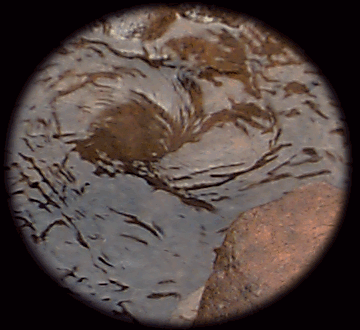
This is the same phenomenon as illustrated by a vortex - like the whirlpool above or the waterspout or hurricane examples - where finding the actual limits of a vortex turns out to be an exercise in polemics. You can trace the formation of the becoming of a basket star or a whirlpool from atomic relationships in the sea and atmosphere right out to the sun and into cosmos.
John Lilly would have us believe conscious connections between beings (well, maybe not basket stars) can extend throughout the cosmos and even into other dimensions. Hot damn.
This brings up an interesting characteristic of the creation of awareness/observer reflection.
Neither the awareness nor the observer nor what is being observed can be said to be independent. They are interdependent. Meaning that whatever one part of the process gets up to changes the larger system, too.
I suppose you will quickly point out that there is a pecking order here. I can observe the sky getting busy, indicating an approaching storm and this will indeed modify my behavior. But whatever I do won't change the weather.
Well, actually.... Would you say that we could change the weather?
Does life influence the weather?
