
- Log of the Moira
- Finding the Thread
- Cruising Asia
- Cruising the Solomon Islands
- Cruising Australia Part 1
- Cruising Papua New Guinea
- Pearls, Pearls, Pearls
- What Am I Doing Here?
- Black, White and Grey in Paradise
- Dubious Mission to Tagula
- Words Appart
- Rascals in Paradise
- Pearl Diving in Doga Sui Sui Pass
- American Spies
- The Giant Man Eating Octopus
- The Great Ebony Caper
- The Uplift Factor
- Planned Failure
- A Tangled Web
- Opposition
- Midnight Sun
- Lapi in the Isles of Love
- Unchartered Waters
- Unnamed Island
- The Isles of Love
- Earthlings
- Nothing Atoll
- Super-Organisms in Time Lapse
- People of the Sea
- Coral Fires Burning
- Symbiotic Coral Megabeasts
- Symbiosis
- A Handy Experiment
- Destiny in Action
- Keops and Kaleidoscopes
- Poisoned and Dying in Sidea
- Dire Straits
- PNG Update
- Cruising Australia Part 2
- Ancient Respected Oracle
- Eye of the Dolphin
- Sydney Dolphin Cult
- Water Wings
- Sydney Dolphin Connection
- Sydney's Dolphinarium
- Dolphin communication
- Starlight Starbright
- Captive Dolphins
- Politics of dolphin liberation
- Sun Heralds Sydney Dolphins
- 40 foot swimming pool
- Media Dolphin Campaign
- Government Goo
- Dolphins in captivity
- Dolphin Referendum
- Australian Media Campaign
- Dolphins to die
- Orcas Visit Moira
- Dolphin Update
- Man and Dolphin
- Cruising New Caledonia
- Cruising Fiji
- Cruising Samoa
- This Magic Sea
- We are
- Awareness
- Learning
- We Voyage This Magic Sea
- Bound for Knowledge
- Beyond Perceptual Horizons
- Facts of Life
- Intercommunications
- Sea's Communication Webs
- Appearing
- 4 Phase Process of Becoming
- Thread of Awareness
- Error of Expectations
- Change of Expectations
- Mind
- Learning
- Fields of Perception
- Guides
- Tides
- Thread of Awareness
- Contact The Moira
E-BOOK VERSIONS
Enjoy these adventures on your ebook reader and help support the Thread of Awareness network of websites by downloading the Log of The Moira ebooks in epub and mobi formats for €5 per ebook or €10 for all three ebooks.

The Complete Series of all three ebooks.
For your mermaid.

CHAOS AND THE OPEN MOUTH SYNDROME
When, in the late 1970's, Physicists discovered fractals, they revealed a strange and foggy part of This Magic Sea.
Nature, it turns out, was responsive in a way nobody even imagined. The discovery dismayed and confused many, but delighted and enlightened others.
It was so strange nobody knew what to call the new field of investigation. Eventually it was nicknamed Chaos Theory and popularized by James Glieck.
Now known as complex number theory, the system of mathematics renovated scientific interest in the dynamics of non-linear systems, like clouds, rivers or life.
The alluring patterns were discovered by a weather scientist who, like all meteorologists, knew that although weather had familiar, repeating patterns, you could never predict exactly what it would do next.
Every cloud in the sky is different from every other one. But each sky has a particular pattern. Although clouds are different from each other they are also similar. A thunderhead looks like a thunderhead, a cirrus like a cirrus.
How does Nature do this? What is it that is similar between different clouds?
Formulae
Some natural phenomena can be reduced to a simple mathematical relationship, a formula. Once the formula is known, the scientist can substitute different numbers for the variables and predict how the relationship will develop under different conditions. This works for some formulae, called linear relationships, but not for non-linear relationships.
When scientists add the value into the formula for a non-linear relationship, they can never predict exactly what the outcome will be.Non linear systems can react in more than one way to what seems to be exactly the same set of conditions. Physicists used the word chaotic to describe this very common behavior, because they thought that if nature didn't do what their formulae predicted, nature must be random, uncoordinated activity. Webster defines chaos as confusion and disorder.
Chaos
Really, the confusion and disorder was in the minds of the scientists, not in Nature. Maybe we mean random, uncoordinated activity when we use the word chaos today, but chaos comes from a Greek word chaos meaning abyss and derived from a still older word chainein to gape as in a chasm or wide open mouth.
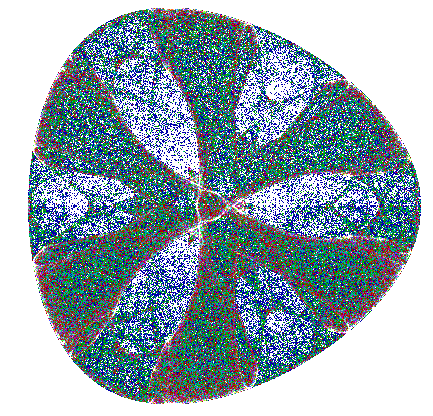
Chaos was the gap between human understanding and the real world; the wide open mouth when scientific predictions failed.With the advent of modern computers and computer hacks who spend all day diddling with them, a whole new world flew into the open mouth of chaos. Solved once, or a few hundred times, the equations describing non-linear behavior yielded meaningless answers. But solved millions of times by high speed computers, the simple non-linear formulas unfolded into fabulous images of reality.
Iterations
The more times the equations were solved, the more detail appeared in the image. There was no end to the detail. Within the general boundaries of the equation the images resolve into an infinity of detail - just like life. There was lots of chaos around the physics labs in the universities when the so-called fractal images started decorating computer screens.
So stunned was the senior physics faculty at one Southern California University they actually forbid the students to continue investigating these aberrations. You just know how that turned out.
Chaos Theory
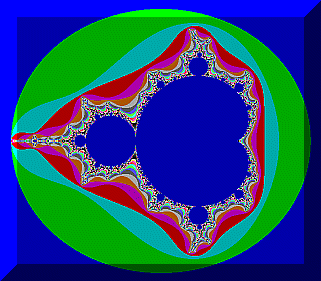
Chaos Theory describes how orderly patterns of behavior emerge from apparently chaotic surroundings. The Mandelbrot set, named after the mathematician who discovered fractal designs, results from the iteration in the complex plane of z -> z2 + c. The formula reveals nothing of the beautiful infinity of patterns resulting from its solution. The letters mean nothing by themselves. The first few solutions (iterations) for the formula present only "random" dots on a graph. The formula must be solved many times by a computer before the patterns become evident. The more times the computer solves the equation, the more detailed and beautiful the pattern on the monitor. Within the boundaries of the set, the patterns implode forever.I have included a program on this disk that lets you play with fractals and generate strikingly beautiful patterns. Hyperlink over to read more about fractals.
Fractals and the uncertainty of change
Fractals open the door to understanding nature's responsive behavior. Nobody is sure why, or how, seemingly random events result in structures of such infinitely expanding symmetry. The old systems of thought can't figure out the cause and effect of Chaos. This is because the reductionism view insists on seeing cause preceding effect and working from the small to the large. Chaos demonstrates the reverse is also true.
What has already happened changes the probability of what will happen next.
That's against classical probability theory. According to that, each time a coin is flipped, the chances of it landing on one side or the other is exactly 50:50. Chaos theory shows, in the complexities of real life, the chances are not really equal and the next throw has a different probability than the last. Not only does it have a different probability, the chances are, each new solution of the equation will add to the construction of a beautiful and symmetrical pattern. The world is constructed like that. Nature isn't random. It is responsive.
The Possibility of Life and Evolution

Life is a clear example of the foolishness of Probability Theory. According to the odds, life is impossible. Any biologist who has studied behavior knows animals have a habit of doing something different every time the researcher thinks an experiment proves something definitive. This is why scientists, by habit, always qualify their statements with "seems to be" or "apparently" or "probably".
Very few scientists have had the courage to investigate Synchronicity. Psychologist C.G. Jung coined the word to describe those totally unexplainable coincidences that happen from time to time. Jung and Sigmond Freud were contemporaries. They were friends, at first, but later Freud shunned Jung. Freud went with the Cartesian world of dualism and reductionism.
Mental disturbances, thought Freud, were caused by individual events that happened in a person's childhood - usually linked with sex. Jung agreed, to a point, but also believed illnesses were also caused by disturbances in a kind of universal unconsciousness. There were, he insisted, ideas everyone held in common, called archetypes. And these controlled how individuals behaved and what happened to them. Violations or suppressions of archetypes, like sex, Jung said, could lead to mental illness. Archetypes, Jung said, were the sort of bonds that kept brothers from banging sisters.Jung wondered if maybe Nature's responsiveness could be more than - impersonal. If maybe nature could somehow be responsible for the strange coincidences he named synchronicity. Maybe?
Bifurcations
In his book, Synchronicity, Jung tells a good story about Freud. Freud was psychoanalyzing a woman who was terrified of birds. With Freud's guidance, she picked through her youthful memories, searching for the reason for this phobia. Freud explained that the incident was buried by her sub-conscious mind, to protect the conscious mind.
Probing for the incident was like arguing with a child to tell a terrible secret. It took years. Then, one day, while she babbled on from the couch and Freud doodled at his desk, the child within finally gave in and let the woman remember that a big bird attacked her when she was a baby. The woman sat up, gasping, remembering the attack perfectly, in every detail (the Child Within gave her the whole scene). She turned to Freud and just as she opened her mouth to speak, a bird flew violently into the glass of the closed window right behind Freud's head. It had never happened to Dr. Freud before, it never happened again. No conceivable set of mathematics could predict this weird coincidence.
Personal Synchronicities
I have experienced synchronicities. I think most people have. Coincidence becomes too small a word for some of them. Just when I need something to happen, it does. I meet just the right person, somebody hands me a book, an unexpected check arrives. I'll tell you about my most remarkable synchronicity. This is a dilly. And I swear to tell it accurately. What's more I have witnesses.
It was in Port Douglas, on the 7 Mile Beach in North Queensland. I was investigating the control systems that guide these strange events, searching - seriously - to figure out what Jung was never able to figure out. Does the larger harmonic mind system that we all create together have the ability to articulate its own wishes by getting individual people to do things.
Hoo, Boy. Like the Gods sending some Greek Hero on a mission. Yeah, well, if you read Log 1, you'll know why I was doing this investigation and maybe not think it was so batty after all. Back to the 7 Mile Beach. This was, incidentally just before the end of the first cruise of the Moira.
Freddy and I were walking down the beach. The various "signals" I had been getting over the past year were confusing, often contradictory, but it seemed to me they formed some kind of a pattern. I was trying to work out what that pattern was.
We stopped and I picked up a stick and started outlining the events in the sand. Rather than scratch out the whole word for each event that I saw as a signal - a clue as to what to do next on this crazy quest, I just put the first letter. I was thinking about Whales and Moirae. I started the voyage seeking answers to the Moirae (M) and fetched up and changed my thinking radically after the incident with the Whales (W). An arrow from M to W. This got me to write a book about the mind (M). And then Walter (W) came back from a visit to the States with an article that made me rethink the book and start producing Moirascopes (M).
Well, I say to Freddy, how am I going to remember all this when all the first letters are the same, W or M? Then I went through the next series of strange coincidences and they all were W's or M's. How odd. What a strange series of weird synchronicities they were. All of them pairs of W and M. I felt sure something was especially important about the relationship of W or M.
I lay on the sand, looking at the ocean, thinking about synchronicity, W or M and how it could possibly all fit together. From my perspective there on the beach, the letters in the sand spell out a message from some power or intelligence greater than I. Each incident spells a change of direction, like a WorM, tracking back and forth - like a signal. Yes, a SIGNAL. Hey, look here, Freddy, it IS a signal. A constant non-random flashing back and forth signal of a mirror image - W or M. Or not exactly a mirror (M) image because the logical type (up and down) is reversed as well as the left and right. Damn! Hot diggity DAMN!By the time we walk back to the road leading to the 7 mile beach I realize I was being silly.
What a lot of nonsense. Just a few odd coincidences. If anything, I say to Freddy, the coincidences were something I made up in my subconscious. Kind of a trick the little brat within played to fuel my curiosity about synchronicity.
I laugh at myself. Freddy holds my hand, no doubt relieved I figured out I was being silly without her telling me so. I chuckle, thinking I'd like to kick the shit out of the little brat within and we walk back towards town feeling OK with the world. No more signals from the great whatever.As we walk, it slowly dawns on me that other individuals were involved in the coincidences.
How could my sub-conscious have influenced their behavior? Walter's coincidence started with him buying me a copy of a Magazine when he was on a trip to America. Walter and the Magazine (W - M) were critical to my reflections on Mind (M). Oh, stop it, I say to the little monster that controls my subconscious.

Freddy and I and the Child Within stop at Lee's house. Lee and Janet are packing their belongings, getting ready to move to another house. Robert, an artist, is helping them pack. The garage is cluttered with junk and they are plowing through it, throwing out some stuff, packing other stuff. Making decisions.
Now, the instant I walk into the garage, the microsecond I step into this busy chaotic scene, Robert reaches into a cardboard box filled with assorted junk and comes up with a paper bag. He opens it, reaches in and pulls out a plastic stick-on letter like they put on boats for registration numbers. As a way of greeting, he holds the letter up to me. I damn near faint. It is the letter W. He laughs and says, "W?" Then he flips it upside down and says, "Or M?"
"Why did you say that?" I ask, astounded. My inner child is falling all over laughing his guts out. I don't know what to think. I decide right then that Robert must have been "controlled" in some way by the great whatever-the-hell-it-is. I am vibrating with the scent. On point.
"Er...because it looks like a W this way and an M that way," he looks at me strangely, like anyone might if a big dog suddenly went on point at them, quivering with energy. He smiles innocently.
He saw me out there on the beach! He couldn't have. Freddy and I were too far from the bushes. He heard me. Not over the surf. Not at 50 meters or more. He was watching with binoculars. No way he could see what I was scribbling in the sand. All ripped through my supercharged mind in a millisecond. No way he could have known!
"Yes, but why did you say that just now? Did you know those letters were in that bag, and the W was on top before I walked up here?" My suspicions are all over my face.
"He's always saying things like that," offers Lee, coming over, smiling friendly. They couldn't have known I was out there thinking about synchronicity. About W or M. Couldn't have known. Not possible.
"But not W or M. Did you ever in your life say that to anyone else?" I demand. He shakes his head, looking worried. Maybe thinking he had somehow offended me, maybe worried about my sanity. "Did you ever hear him say W or M like that before?" I ask Lee. He shakes his head, shrugs his shoulders, and joins Robert looking worried about my sanity.
"I didn't think so," I mumble. Freddy and I just stand there. Janet, Lee and Robert just stand there. Robert still holding the W or M black vinyl stick on letter. 4 inches high. Freddy and I look at each other. I try to think of something to say. I explain. Tell them about the message in the sand. The W or M message on the subject of synchronicity. Why I wanted to know what Robert felt like before he actually reached in the bag and pulled out the W or M. Then Freddy and I wander off down the street, back to the Moira. Our friends get back to packing.
So what are the statistical probabilities of that? It was impossible. IMPOSSIBLE! Unless....
I thought about Kitchner Wheatley in the Solomon Islands. And his strange synchronicities. And the more meaningful synchronicity story I know.
There are innumerable examples of synchronicity. Only the brain dead would insist they are all meaningless, random, chance events. Such minds have no possibility of grasping Chaos Theory until it happens to them. Whereupon they discover all about chaos and the open mouth syndrome.
So what I want to know, what bothers me, is not if some kind of Jungian panconscious human awareness exists. We see it in action every day on the stock market. What bothers me is this. Can this panconsciousness, especially the one we make with our sub-conscious (or super-conscious) communications, somehow reach out and grab Robert's hand and make him lift out a letter he didn't even know was there and then hold it up to me the instant I walk in the garage and without a moment's hesitation say, while smiling, "W, or M?"
There is another demonstration of how the larger system controls what happens to the smaller one. It is less strange, but equally remarkable. The phenomenon of learning.
